Foundations • Lesson 2
The Nine Biological Hallmarks of Ageing Explained Simply
A beginner-friendly guide to what actually drives ageing inside your cells — and why the same simple habits support many ageing pathways at once.
Ageing can feel mysterious, but modern science shows it follows recognisable biological patterns. These patterns are known as the hallmarks of ageing.
In the first guide, Why Longevity Matters, we looked at the difference between lifespan and healthspan. This second foundation goes one layer deeper: what actually changes inside the body as we age?
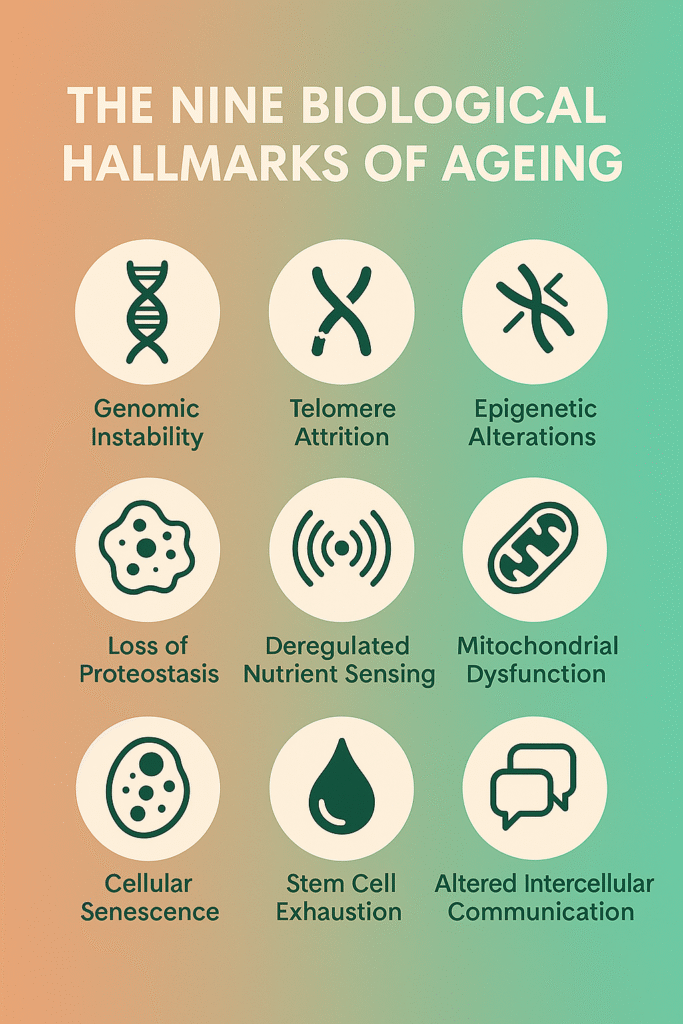
Scientists describe the main biological drivers of ageing as the hallmarks of ageing. These include DNA damage, telomere shortening, epigenetic drift, protein damage, weaker nutrient sensing, mitochondrial dysfunction, senescent cells, stem cell exhaustion, and poor communication between cells.
That sounds technical, but the big idea is simple: ageing is not one single process. It is a collection of linked changes that gradually reduce resilience. The good news is that many of these pathways respond to the same foundations: movement, nutrition, sleep, stress regulation, metabolic health, and recovery.
Table of Contents
- The nine hallmarks of ageing overview
- 1. Genomic instability
- 2. Telomere shortening
- 3. Epigenetic changes
- 4. Loss of proteostasis
- 5. Deregulated nutrient sensing
- 6. Mitochondrial dysfunction
- 7. Cellular senescence
- 8. Stem cell exhaustion
- 9. Altered intercellular communication
- Summary: the hallmarks in plain English
- What to do next
- FAQs
- References
- Next steps
The nine hallmarks of ageing overview
The hallmarks of ageing are the recurring biological changes that appear as organisms grow older. They help explain why energy declines, tissues become less resilient, recovery slows, inflammation rises, and disease risk increases with age.
You do not need to memorise every term. Instead, use this page as a simple map. Each hallmark shows one way the body becomes less able to repair, adapt, and stay balanced over time.
Simple takeaway
Ageing is not random. It is a set of connected biological changes — and many of them are influenced by the way you move, eat, sleep, recover, and manage stress.
1. Genomic instability: damage to your DNA
Your DNA is like the instruction manual inside your cells. It tells cells how to build proteins, repair themselves, and function properly.
Over time, DNA can become damaged by normal metabolism, inflammation, toxins, ultraviolet light, poor sleep, oxidative stress, and simple wear and tear. Your body has repair systems, but those systems become less efficient with age.
- What it means: DNA damage builds up faster than the body can fully repair it.
- Why it matters: Faulty instructions can reduce cell function and increase disease risk.
- How to support it: Prioritise sleep, colourful plant foods, regular movement, sun safety, and lower chronic stress.
2. Telomere shortening: protective caps wearing down
Telomeres are protective caps at the ends of chromosomes. They help keep DNA stable when cells divide.
Each time a cell divides, telomeres can become shorter. When they become too short, the cell may stop dividing or enter a damaged state. This is one reason tissues become less able to renew themselves with age.
- What it means: Cells gradually lose some of their ability to make healthy new copies.
- Why it matters: Shorter telomeres are associated with lower resilience and age-related decline.
- How to support it: Regular aerobic exercise, stress regulation, good sleep, and anti-inflammatory eating patterns.
3. Epigenetic changes: your cellular settings shift
If DNA is the instruction manual, the epigenome is the control system that decides which instructions get switched on or off.
With age, these settings can drift. Cells may stop behaving as precisely as they once did. This can affect repair, inflammation, metabolism, and tissue identity.
- What it means: The switches that control cell behaviour become less accurate.
- Why it matters: Cells may lose some of their original function and repair capacity.
- How to support it: Strength training, whole-food nutrition, regular sleep timing, daylight exposure, and fewer ultra-processed foods.
4. Loss of proteostasis: protein clean-up systems slow down
Proteins do much of the work inside your body. They need to be folded correctly, repaired when damaged, and cleared away when they are no longer useful.
As we age, the systems that manage protein quality control become less efficient. Misfolded or damaged proteins can build up, creating cellular clutter and contributing to dysfunction.
- What it means: Cells struggle to keep proteins stable, clean, and usable.
- Why it matters: Protein build-up is linked with inflammation and age-related disease.
- How to support it: Exercise, sleep, hydration, adequate protein, and healthy autophagy signalling.
This is why the next foundation guide focuses on your body’s clean-up system: Autophagy Explained Simply.
5. Deregulated nutrient sensing: metabolic signals go out of balance
Your cells use nutrient-sensing pathways to decide whether to grow, repair, store energy, burn energy, or conserve resources.
With age, these signals can become less responsive. Insulin sensitivity may decline, blood sugar may become harder to control, and growth-and-repair pathways may become less balanced.
- What it means: The body becomes less responsive to key metabolic signals.
- Why it matters: Poor nutrient sensing contributes to inflammation, metabolic disease, fatigue, and accelerated ageing.
- How to support it: Zone 2 training, walking after meals, protein-focused meals, fibre, and fewer ultra-processed foods.
Useful next reads: Blood Sugar and Longevity and Metabolic Flexibility Explained Simply.
6. Mitochondrial dysfunction: the cell’s powerhouses struggle
Mitochondria turn food and oxygen into usable energy. They are often described as the powerhouses of the cell.
As we age, mitochondria can become less efficient. They may produce less usable energy and more oxidative stress. This can affect energy, recovery, metabolism, brain health, and physical capacity.
- What it means: Cells produce energy less efficiently.
- Why it matters: Poor mitochondrial function is linked with fatigue, metabolic decline, and reduced resilience.
- How to support it: Zone 2 cardio, strength training, walking, good sleep, and natural light exposure.
For a practical starting point, read Zone 2 Cardio for Longevity.
7. Cellular senescence: damaged cells stop working but do not go away
When a cell becomes too damaged, it can enter a state called senescence. In simple terms, it stops dividing but does not fully disappear.
Senescent cells can release inflammatory signals that affect nearby healthy cells. Over time, this can contribute to chronic inflammation and tissue ageing.
- What it means: Worn-out cells remain active in a harmful way.
- Why it matters: Senescent cells can drive inflammation and accelerate tissue decline.
- How to support it: Movement, sleep, healthy body composition, anti-inflammatory nutrition, and repair-supporting habits.
8. Stem cell exhaustion: your repair team slows down
Stem cells help repair and regenerate tissues. They are part of the body’s maintenance and recovery system.
With age, stem cells can become fewer, less active, or less effective. This helps explain why healing slows, tissues lose resilience, and recovery takes longer.
- What it means: The body’s repair capacity declines.
- Why it matters: Healing, immune function, and tissue renewal become less efficient.
- How to support it: Strength training, adequate protein, sleep optimisation, stress control, and lower chronic inflammation.
9. Altered intercellular communication: cells stop talking clearly
Your cells are constantly communicating. They send signals that coordinate growth, repair, immunity, inflammation, metabolism, and recovery.
As we age, this communication can become noisier. Inflammatory signals rise, repair signals weaken, and the immune system can become less accurate.
- What it means: The messaging network between cells becomes disrupted.
- Why it matters: Inflammation rises and recovery signals become less clear.
- How to support it: Sleep quality, stress regulation, anti-inflammatory foods, omega-3 sources, gut health, and regular movement.
Helpful next reads: Anti-Inflammatory Foods, Stress and Longevity, and Gut Health and the Microbiome.
Summary: the hallmarks in plain English
The nine hallmarks show that ageing is not one problem. It is a network of linked changes. However, the practical message is encouraging: you do not need nine separate protocols.
The simple version
- DNA damage builds up — so support repair with sleep, plants, movement, and lower chronic stress.
- Telomeres shorten — so protect resilience with aerobic fitness and stress regulation.
- Epigenetic settings drift — so reinforce healthy signals with strength training, daylight, and whole foods.
- Proteins become cluttered — so support clean-up through sleep, exercise, and autophagy.
- Nutrient sensing weakens — so stabilise blood sugar and improve metabolic flexibility.
- Mitochondria slow down — so train your aerobic base and move daily.
- Senescent cells accumulate — so reduce chronic inflammation and maintain healthy body composition.
- Stem cells tire — so prioritise recovery, protein, strength, and sleep.
- Cell communication becomes noisy — so support gut health, stress regulation, movement, and anti-inflammatory eating.
This is the heart of Longevity Simplified: a few repeated habits influence many ageing pathways at once.
What to do next
The most useful response to the hallmarks is not fear or complexity. It is a simple foundation that supports repair, energy, metabolism, and resilience.
- Move daily: combine walking, Zone 2 cardio, and 2–3 short strength sessions each week.
- Eat mostly whole foods: build meals around plants, protein, fibre, and healthy fats.
- Protect sleep: keep a consistent sleep window and a calmer pre-bed routine.
- Lower chronic stress: use breathwork, daylight, breaks, social connection, and realistic workload boundaries.
- Support metabolic health: avoid constant snacking, manage blood sugar, and build metabolic flexibility.
- Use supplements selectively: fill specific gaps rather than chasing every trend.
Helpful next reads: The Optimal Longevity Diet, Best Exercises for Longevity, How to Improve Sleep for Longevity, and Best Supplements for Longevity.
Simple takeaway
The hallmarks explain the science. Your daily habits send the signals. Start with the basics and let them compound.
FAQs
Do I need to memorise all nine hallmarks?
No. It is more useful to understand the overall idea: ageing is a set of linked biological changes, and the basics of movement, nutrition, sleep, and stress control influence many of them at once.
Can I test my biological age or hallmarks directly?
Some commercial tests estimate biological age using epigenetic markers or blood data. They can be interesting, but they are not perfect and are still evolving. Most people should focus first on strength, fitness, metabolic health, sleep, and recovery.
Are there drugs that target the hallmarks of ageing?
Researchers are studying drugs and compounds that may target specific hallmarks, including senescent cells, nutrient-sensing pathways, and inflammation. However, these are not a replacement for lifestyle foundations and should only be considered with proper clinical guidance.
Where should I start if the nine hallmarks feel overwhelming?
Start with one habit that improves several hallmarks at once. A daily walk, two weekly strength sessions, a regular sleep window, or an extra serving of plants at dinner is enough to begin.
Which hallmark is most important?
There is no single most important hallmark for everyone. The hallmarks interact with each other, which is why broad foundations like movement, sleep, nutrition, metabolic health, and stress regulation are so powerful.
References
Key research and further reading used to create this simplified guide:
- López-Otín C. et al. The Hallmarks of Aging. Cell, 2013.
- López-Otín C. et al. Hallmarks of Aging: An Expanding Universe. Cell, 2023.
- Kennedy BK. et al. Geroscience: linking aging to chronic disease. Cell, 2014.
- Kaeberlein M. The Biology of Aging: Citizen Scientists and Their Pets as a Bridge Between Research on Model Organisms and Human Subjects. Veterinary Pathology, 2016.
- Campisi J. Cellular senescence: putting the paradoxes in perspective. Current Opinion in Genetics & Development, 2011.
- Longo V. D. and Panda S. Fasting, circadian rhythms, and time-restricted feeding in healthy lifespan. Cell Metabolism, 2016.
These papers contain the deeper scientific explanations. This article focuses on the practical ideas a beginner can actually use.
Next steps: use the hallmarks as a guide, not a checklist
The nine hallmarks help you understand what is happening beneath the surface as the body ages. But they are not meant to create anxiety or a complicated to-do list.
The practical lesson is simple: strengthen fitness, protect sleep, improve nutrition, stabilise blood sugar, lower chronic stress, and many ageing pathways improve together.

Simon is the creator of Longevity Simplified, where he breaks down complex science into simple, practical habits anyone can follow. He focuses on evidence-based approaches to movement, sleep, stress and nutrition to help people improve their healthspan.