Best Exercises for Longevity (No Gym Required)
Movement is one of the strongest “longevity drugs” we have — and it’s free. You don’t need a gym membership, fancy gear or long workouts to benefit. This guide shows simple, science-backed ways to move for a longer, healthier life.
Disclaimer: This article is educational and not medical advice. If you have a health condition, pain, or take medication, speak with your GP/clinician before changing your activity level or starting a new exercise routine.
Longevity isn’t just about how long you live — it’s about how well you function as you age. Movement connects directly to several hallmarks of ageing, including muscle loss, mitochondrial function, inflammation and metabolic health. In practice, exercise is one of the most “multi-system” habits you can build.
The goal here isn’t perfect workouts — it’s creating a weekly rhythm that keeps you strong, mobile, and resilient for decades. If you want a simple framework to organise your week, start with the Movement & Strength Blueprint.
How I think about movement in my own routine
When I first started paying attention to longevity, I assumed exercise meant long workouts, complicated programmes, or hours in the gym. The reality was much simpler: the days where I walked, did a few strength movements at home, and stretched in the evening consistently felt better. My sleep improved, my energy felt steadier, and everyday tasks felt easier.
What helped most was lowering the bar. Instead of chasing “perfect”, I focused on minimum-effective habits: a 20-minute walk, a few sets of squats and push-ups, and some balance work. Over time, those small sessions compounded — and, importantly, they felt sustainable instead of overwhelming.
That’s the approach this guide takes: simple movements that fit into a real day, not an ideal one.

Why exercise helps you live longer
Regular movement doesn’t just “burn calories” — it improves almost every system involved in healthy ageing. Even modest, consistent activity can make a meaningful difference to:
- Muscle and bones: maintains strength and bone density, supporting independence and stability.
- Heart and circulation: supports healthier blood pressure, blood vessel function and cardiovascular resilience.
- Brain and mood: increases blood flow and supports mood, focus and memory.
- Inflammation and blood sugar: improves insulin sensitivity and helps calm chronic inflammation.
- Sleep and stress: moving in the day tends to improve sleep quality and stress tolerance.
For longevity, the aim isn’t heroic workouts — it’s building a lifestyle where moving your body becomes normal. If you want the “engine” side, read Zone 2 Cardio. If you want the metabolic angle, pair this with Blood Sugar and Longevity. For general recommendations, the NHS overview is useful: NHS physical activity guidance.
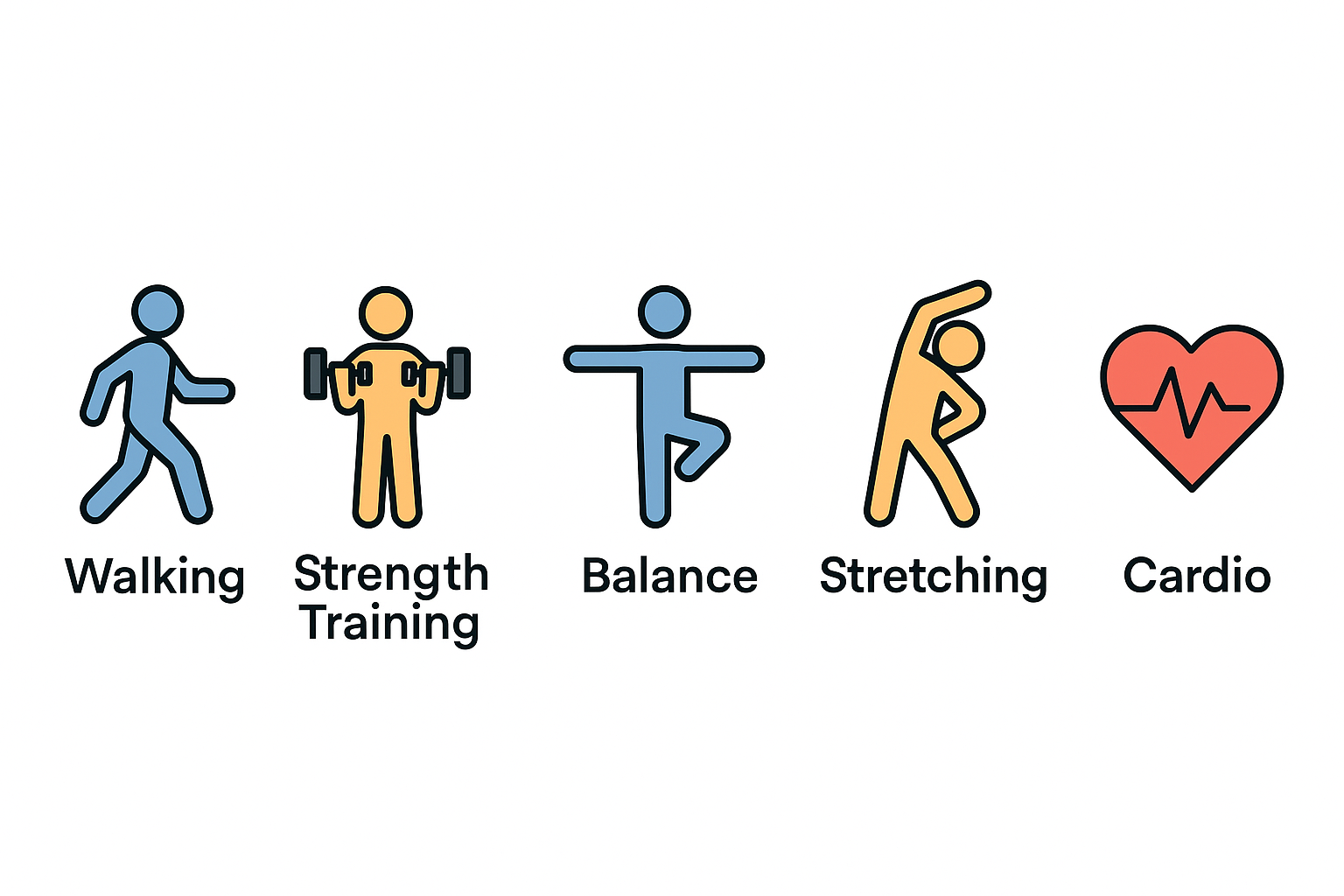
5 simple longevity exercises anyone can start
All of these can be done at home or outside, with little or no equipment.
1) Walking (daily)
Why it matters: Walking is one of the most studied and accessible forms of exercise. It supports heart and brain health, lowers stress, improves blood sugar control, and builds endurance without hammering your joints.
How to start: Aim for 20–30 minutes on most days. Break it up if needed: 2 × 10 minutes or 3 × 8–10 minutes still counts.
How to progress: Walk a little faster, add a hill, or extend time gradually. If you want more targeted “easy cardio”, use the talk test and build toward Zone 2 (see Zone 2 Cardio).
2) Strength training (2–3× per week)
Why it matters: We naturally lose muscle and strength as we age. Strength training slows that loss, supports balance and bone density, stabilises joints, and helps keep blood sugar under control. It’s one of the highest-return habits for long-term independence.
Simple beginner routine (no equipment):
- Chair squats (sit-to-stands): 6–10 reps
- Wall or counter push-ups: 6–10 reps
- Hip hinge pattern: 8–12 reps
- Step-ups: 6–10 reps each leg
Start with 1–2 rounds, resting as needed. When it feels easier, add a third round or a few reps. For a full beginner structure, see Strength Training for Longevity and Strength Training After 40.
3) Balance & mobility (most days, 2–5 minutes)
Why it matters: Balance reduces fall risk (a major driver of loss of independence later in life). Mobility keeps joints comfortable and makes everyday movement easier.
How to start (stand near a wall/counter):
- Single-leg stand for 10–20 seconds each side
- Heel-to-toe walk along a hallway
- Gentle ankle/hip/shoulder circles
Progress by turning your head left/right, looking up/down, or briefly closing your eyes (only if safe and steady).
4) Stretching or gentle yoga (5–10 minutes)
Why it matters: Gentle stretching/yoga eases stiffness (hips, back, shoulders) and pairs well with an evening wind-down. It can also support sleep and stress relief.
- Calf stretch against a wall
- Hip flexor stretch (half-kneeling)
- Child’s pose or gentle forward fold
- Slow shoulder circles and chest-opening stretches
Move slowly, breathe steadily, and avoid pushing into sharp pain. If sleep is a goal too, see Sleep for Longevity (UK).
5) Low-impact cardio (1–3× per week)
Why it matters: Low-impact cardio strengthens your heart and lungs while being gentle on joints. It’s a simple way to improve stamina and recovery.
Options: brisk walking, cycling, swimming, rowing, or low-impact home workouts.
How to start: Begin with 10–15 minutes at a comfortable pace and add 2–5 minutes per week until you reach 20–30 minutes.
Simple weekly longevity plan (beginner)
Use this as a gentle starting point. Adjust days to fit your schedule and energy.
- Mon: 20–30 min walk + 1–2 min balance
- Tue: strength routine (1–2 rounds) + 5 min stretching
- Wed: 20 min walk
- Thu: strength routine (1–2 rounds) + 5 min stretching
- Fri: 20–30 min walk
- Sat: low-impact cardio 15–25 min (cycle/swim/brisk walk)
- Sun: rest day or 5–10 min gentle mobility
On busy weeks, use “movement snacks”: 3 × 8–10 minute walks plus one quick strength set on two days. Consistency beats perfection.
Optional simple equipment (UK-friendly)
You can do everything above with bodyweight and a bit of space. However, a few basics can make consistency easier and progress smoother.
- Resistance bands: joint-friendly, low-cost strength training at home.
- Exercise mat: more comfortable for mobility and floor work.
- Light dumbbells or a kettlebell: optional, useful once bodyweight feels easy.
- Comfortable walking shoes: the “best” upgrade if walking is your main habit.
For tracking and consistency tools, see Wearables & Recovery Tracking and Resources.
Safety & progress tips
- Warm up with a gentle 3–5 minute walk or joint circles.
- Use a wall/chair/counter for support during balance work.
- Progress gradually by changing one thing at a time: reps, rounds, distance, or pace.
- Mild muscle fatigue is normal; sharp pain, chest pain, dizziness or unusual breathlessness is not.
- Rest days are part of training — recovery is when your body adapts.
If you’re building the “full stack” (movement + sleep + nutrition + stress), these pair well: Sleep • Anti-inflammatory foods • Stress and longevity.
FAQs
Do I need a gym membership for longevity exercise?
No. Walking, basic bodyweight strength work, and short mobility sessions at home are more than enough to start. A gym can be helpful later if you enjoy it, but it isn’t required.
How much should I exercise for longevity?
A realistic target is movement on most days, plus 2–3 short strength sessions per week. Start with what you can do consistently and build slowly.
Is walking alone enough?
Walking is a brilliant foundation. For best long-term protection, add some strength and balance work so you maintain muscle, bone and stability as you age.
Am I too old to start strength training?
In most cases, no. People can gain strength at almost any age with the right starting point. Begin with chair squats and wall push-ups and progress gradually. If you have concerns, speak with your GP first.
References
- NHS – Physical activity guidance
- World Health Organization – Physical activity fact sheet
- British Heart Foundation – activity and heart health
- Peer-reviewed research on resistance training, sarcopenia prevention, aerobic conditioning, and healthy ageing outcomes.
If you take one thing from this…
You don’t need perfect workouts — you need a repeatable weekly rhythm. A regular walk, two short strength sessions, and a few minutes of balance/mobility is a powerful longevity foundation.
Want the simple weekly structure to follow?
Use the Movement & Strength Blueprint to combine daily movement, strength, and Zone 2 in one plan.
Next steps
Affiliate disclaimer: Some links may be affiliate links. If you buy through them, we may earn a small commission at no extra cost to you. We only recommend products we genuinely believe are useful.
Written by Longevity Simplified — turning complex science into simple daily actions.

Simon is the creator of Longevity Simplified, where he breaks down complex science into simple, practical habits anyone can follow. He focuses on evidence-based approaches to movement, sleep, stress and nutrition to help people improve their healthspan.