Biology of Ageing • Cellular Energy • Healthspan
Mitochondria & Ageing: The Simple Guide to Your Body’s Energy Engines
Why the tiny power plants inside your cells quietly determine how fast — or how well — you age.
This article is part of the Biology of Ageing hub, where we explain the core mechanisms that drive ageing — and how everyday habits influence them over time.
Disclaimer: This article is for educational purposes only and does not replace medical advice. If you have a medical condition, severe fatigue symptoms, or take prescription medication, speak with a qualified healthcare professional before making major lifestyle or supplement changes.
Mitochondria are often described as the “powerhouses of the cell,” which sounds abstract until you connect it to real life. When your mitochondria work well, you tend to feel more energised, resilient, mentally clear, and physically capable. When they don’t, fatigue creeps in, recovery slows, inflammation rises — and ageing feels faster.
Mitochondrial health sits near the centre of longevity. It influences how efficiently you produce energy, how you handle stress, how stable your blood sugar is, and how quickly your cells accumulate damage over time.
Personal note: the biggest “tell” for me isn’t motivation — it’s recovery. When I’m sleeping well and moving consistently, my energy feels cleaner and more stable. When I’m sedentary and sleep is patchy, everything feels heavier. That’s mitochondria in real life.
In this guide, you’ll learn:
- what mitochondria actually do (in plain language)
- how mitochondrial function changes as we age
- how mitochondria link to metabolism, inflammation, and chronic disease risk
- simple daily habits that protect and improve mitochondrial health
1) The simple explanation
Every cell in your body needs energy to function. Mitochondria are the tiny structures inside your cells that turn food and oxygen into usable energy (ATP).
Think of mitochondria as microscopic power plants: they take in fuel + oxygen, generate energy, and produce “exhaust” in the process.
When mitochondria are healthy, they tend to:
- produce steadier, more efficient energy
- generate fewer damaging by-products
- support repair, recycling, and resilience
- help regulate metabolism and inflammatory signalling
When mitochondrial function declines, the pattern flips:
- low energy and brain fog
- slower recovery from exercise or illness
- higher baseline inflammation
- greater risk of metabolic and age-related disease
In many ways, mitochondrial health determines how “young” your cells behave.
2) How mitochondria work (without the jargon)
A) Mitochondria turn fuel into ATP.
They convert carbohydrates and fats (and sometimes amino acids) into ATP — the energy currency that powers muscle contraction,
brain activity, hormone production, and cellular repair.
B) Energy production creates by-products.
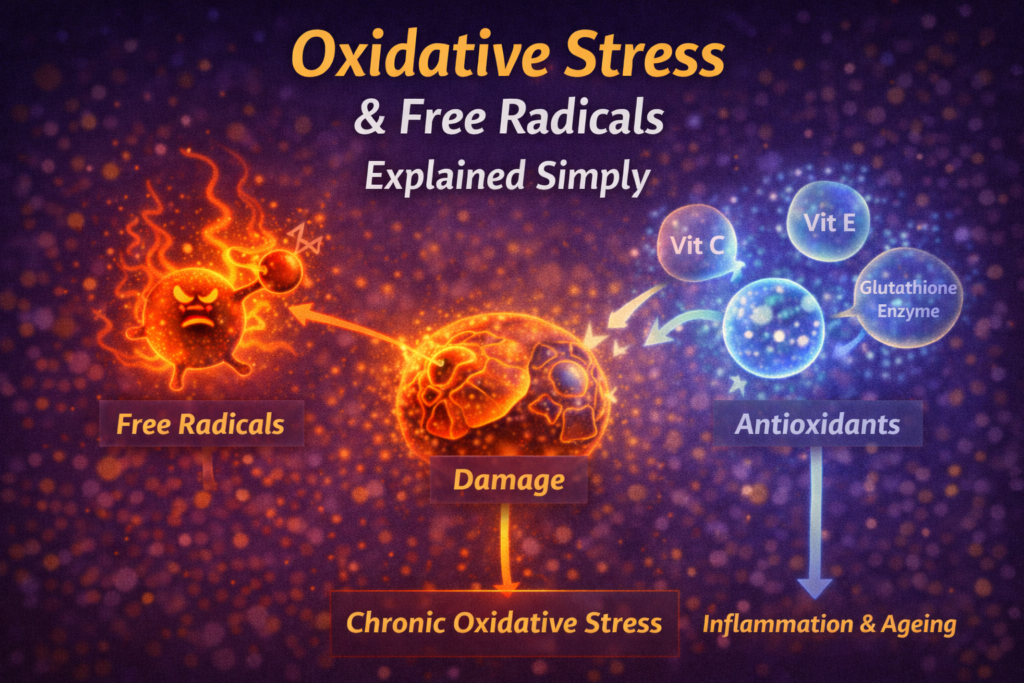
While making ATP, mitochondria also generate reactive oxygen species (ROS). In small amounts, ROS are useful signals.
In excess, they contribute to oxidative stress and cellular damage.
(If you want the “plain English” version of this, see Oxidative Stress & Free Radicals Explained Simply.)
C) Mitochondria adapt to demand.
When you move, sleep well, and challenge your body in healthy doses, mitochondria tend to become more efficient and resilient.
When you’re sedentary, overfed, sleep-deprived, or chronically stressed, they downshift.
D) Mitochondria “talk” to the rest of the cell.
They influence inflammation, insulin sensitivity, stress responses, and signalling pathways linked to repair.
When mitochondrial signalling is poor, the body drifts toward “damage management” rather than long-term maintenance.
If you want a credible overview of mitochondrial biology and why dysfunction matters in ageing and disease, the National Library of Medicine has a solid starting point here: Mitochondrial dysfunction in ageing and disease (PMC).
3) What happens to mitochondria as you age
Ageing doesn’t “break” mitochondria overnight. Instead, it gradually changes their quality, efficiency, and turnover.
Common age-related shifts include:
- reduced efficiency of energy production
- greater leakage of reactive by-products
- slower removal of damaged mitochondria (mitophagy)
- reduced creation of new mitochondria (biogenesis)
As a result, cells spend more energy dealing with damage — and less on function, repair, and resilience.
Mitochondrial dysfunction connects to multiple mechanisms from the Nine Hallmarks of Ageing, including chronic inflammation and metabolic decline. It also overlaps with related biology clusters like: Cellular Senescence (“Zombie Cells”) and Protein Folding & Repair.
The encouraging part: mitochondria remain responsive to lifestyle signals — even later in life.
4) The signals that upgrade (or degrade) mitochondria
Mitochondria respond to repeated signals. You don’t need perfection — you need the right signals most days.
Signals that upgrade mitochondria
- Regular aerobic work (especially Zone 2) → improves efficiency and endurance capacity
- Strength training → maintains muscle (a mitochondria-rich tissue) and improves glucose disposal
- Movement frequency (steps, short walks) → keeps energy systems “online” all day
- Stable blood sugar → less metabolic strain and fewer energy crashes
- Good sleep → better repair, turnover, and stress tolerance
Signals that degrade mitochondria over time
- chronic inactivity (low demand)
- frequent ultra-processed, high-calorie meals (high load)
- poor sleep (low repair)
- chronic stress (no recovery)
- “all gas, no brakes” training (overstress without recovery)
This is why mitochondrial health is tied so tightly to insulin resistance and metabolic flexibility. When fuel use gets rigid, mitochondria tend to struggle.
5) The Mitochondrial Longevity Framework
Supporting mitochondria isn’t about hacks. It’s about sending simple signals consistently. I like to think in four pillars:
1) Fuel quality
What you eat influences how “cleanly” mitochondria burn fuel.
- mostly whole, minimally processed foods
- adequate protein for repair
- healthy fats (e.g., extra virgin olive oil)
- slow, fibre-rich carbohydrates
- fewer ultra-processed foods and liquid calories
2) Energy demand
Mitochondria respond to demand. Regular movement tells the body: “build capacity.” Too little demand signals decline.
3) Recovery and repair
Sleep and rest allow damaged mitochondria to be repaired or recycled. Without recovery, even “healthy stress” can backfire.
4) Micronutrients and environment
Mitochondrial enzymes rely on vitamins, minerals, oxygen, and a low-toxin environment. Chronic stress, poor sleep, and nutrient gaps work against them.
6) Daily habits that support mitochondria
A) Move in a mitochondria-friendly way
- Zone 2 cardio 2–4×/week (steady, conversational pace) → Zone 2 Cardio
- Strength training 2×/week → Strength Training for Longevity
- Daily walking (especially after meals) → Why Walking After Meals Extends Lifespan
B) Eat to reduce “metabolic smoke”
- build meals around whole foods
- prioritise protein at each meal
- use healthy fats like olive oil and nuts
- avoid frequent large blood sugar spikes
- eat colourful plants for polyphenols and fibre
If you want the practical version of this, start here: Blood Sugar & Longevity and Anti-Inflammatory Foods.
C) Protect sleep and recovery
- aim for 7–9 hours of sleep
- consistent sleep/wake window
- lower light + stimulation in the evening
- avoid intense late-night training if it disrupts sleep
D) Use hormesis intelligently (optional, not essential)
Cold and heat can add a small “adaptation signal,” but they should sit on top of the fundamentals (movement, food quality, sleep, stress regulation).
E) Consider targeted support (only if foundations are solid)
Mitochondria rely on micronutrients (like magnesium and B vitamins), and some people explore targeted options like CoQ10/ubiquinol. However, supplements are support tools — not the core strategy.
7) Quick wins
- add one extra 10-minute walk today
- do a 5–10 minute post-meal walk after your largest meal
- swap one ultra-processed snack for whole food
- move bedtime 15–30 minutes earlier for a week
- add one Zone 2 session this week
8) What not to do
- don’t jump into extreme fasting without stable nutrition and recovery
- don’t rely only on high-intensity training (you still need aerobic base + recovery)
- don’t chase supplements before habits
- don’t normalise chronic sleep loss
- don’t ignore stress load (it changes fuel use and recovery)
9) A realistic mitochondria-friendly week
- Daily: steps + one short post-meal walk
- 2–3×/week: Zone 2 cardio
- 2×/week: full-body strength
- Most meals: protein + fibre + whole foods
- Most nights: consistent wind-down and solid sleep window
This approach isn’t perfect — it’s repeatable. And repeatable signals are what mitochondria respond to best.
10) FAQs
Can damaged mitochondria be improved?
You can’t reverse everything, but you can improve efficiency and promote turnover of weaker mitochondria through movement, nutrition, sleep, and stress management.
Do I need special tests?
Usually no. Useful signals include energy stability, recovery, resting heart rate, aerobic fitness, and blood sugar control patterns.
Is more exercise always better?
No. Mitochondria improve with the right balance of stress and recovery. Too much intensity with poor sleep can backfire.
How does mitochondria relate to insulin resistance?
They’re tightly linked. When fuel processing becomes inefficient, blood sugar control tends to worsen — and vice versa.
See: Insulin Resistance: The Hidden Metabolic Driver of Ageing.
Are antioxidants always good for mitochondria?
Not always. Your body needs a small amount of oxidative signalling for adaptation. The goal is balance, not zero ROS.
Start here: Oxidative Stress Explained Simply.
11) UK-specific notes
- in winter, prioritise indoor Zone 2 options (incline walk, bike, rower) to stay consistent
- budget-friendly mitochondrial staples: oats, beans/lentils, eggs, frozen veg, tinned fish, Greek yoghurt
- walking after meals is one of the easiest “UK-realistic” habits (even 5 minutes counts)
- if morning daylight is limited, get outside briefly at midday to support circadian rhythm
Want the simplest “energy + metabolism” upgrade?
Mitochondria thrive when your body can switch between fuels smoothly. That’s the core idea behind metabolic flexibility — and it’s one of the highest-return longevity skills you can build.
Related articles
- Insulin Resistance — The Hidden Metabolic Driver of Ageing
- Oxidative Stress & Free Radicals Explained Simply
- Cellular Senescence (“Zombie Cells”) Explained Simply
- Protein Folding & Repair: An Easy Explanation
- The Nine Hallmarks of Ageing
- Zone 2 Cardio for Longevity
- Blood Sugar & Longevity
- Sleep for Longevity (UK)
If you take one thing from this…
Healthy mitochondria mean better energy now and slower ageing over time. You support them with simple, repeatable habits — steady movement, stable fuel, and real recovery — not complex hacks.
References
- Sun N, Youle RJ, Finkel T. The Mitochondrial Basis of Aging. Molecular Cell. 2016.
- Lane RK, Hilsabeck T, Rea SL. The role of mitochondrial dysfunction in age-related diseases. Biochim Biophys Acta. 2015.
- NCBI/PMC overview: Mitochondrial dysfunction in ageing and disease. View source
Disclaimer: This content is for educational purposes only and does not replace medical advice. If you have persistent fatigue, unexplained symptoms, or a medical condition, speak to a qualified clinician.
— Simon, Longevity Simplified

Simon is the creator of Longevity Simplified, where he breaks down complex science into simple, practical habits anyone can follow. He focuses on evidence-based approaches to movement, sleep, stress and nutrition to help people improve their healthspan.