Movement & Strength • Blueprint
Movement & Strength Blueprint
A simple weekly structure for movement, cardio and strength — designed for long-term health, not athletic perfection.
Most people don’t fail because they lack motivation. They fail because the plan is too complicated to repeat. This blueprint gives you a realistic rhythm that protects your heart, muscles, joints, and independence as you age — with or without a gym.
Movement is one of the strongest longevity levers we have, because it touches almost every system: cardiovascular fitness, metabolic health, brain function, mood, musculoskeletal strength, and even sleep quality. However, the goal isn’t to train like an athlete — it’s to keep your body capable for decades.
I’ve found the biggest unlock is treating movement like brushing your teeth: a baseline you protect, then you add “extras” when life allows. This guide is the baseline.
Where to go next (inside this hub)
- Strength Training for Longevity — your muscle + bone foundation.
- Zone 2 Cardio for Longevity — your aerobic “engine”.
- VO₂ Max Explained — the fitness metric most linked to lifespan.
- Daily Movement & Steps for Healthspan — the habit that makes everything easier.
Table of Contents
- 1. Why movement is a longevity multiplier
- 2. The 5 movement qualities that matter most
- 3. The Minimum Effective Dose approach (MED)
- 4. A weekly blueprint you can actually repeat
- 5. How to progress without burning out
- 6. If you’re starting from low fitness
- 7. Common mistakes that derail consistency
- 8. Next steps (deeper guides)
- FAQ
1. Why movement is a longevity multiplier
You don’t need extreme workouts to get most of the benefits. In practice, the biggest gains come from: frequent low-stress movement, basic strength, and aerobic fitness maintained over years.
- Cardiovascular: improves blood flow, resting heart rate, and long-term heart resilience.
- Metabolic: supports insulin sensitivity and reduces the “sitting-driven” slowdown most adults experience.
- Muscle & bone: protects against age-related muscle loss (sarcopenia) and fracture risk.
- Brain & mood: improves stress tolerance, sleep quality, and cognition over time.
The key isn’t intensity — it’s repeatability. If you can’t repeat it for months, it’s not your plan.
Related: Minimum Effective Dose Exercise for Longevity • Walking as a Longevity Superpower
2. The 5 movement qualities that matter most
Think of longevity training as building five “movement qualities”. You don’t need perfection — you need coverage.
-
Daily movement (NEAT): steps, errands, short walks, stairs — the metabolism-friendly baseline.
Daily Movement & Steps for Healthspan → -
Aerobic base (Zone 2): easy, conversational pace cardio that supports mitochondrial function and endurance.
Zone 2 Cardio for Longevity → -
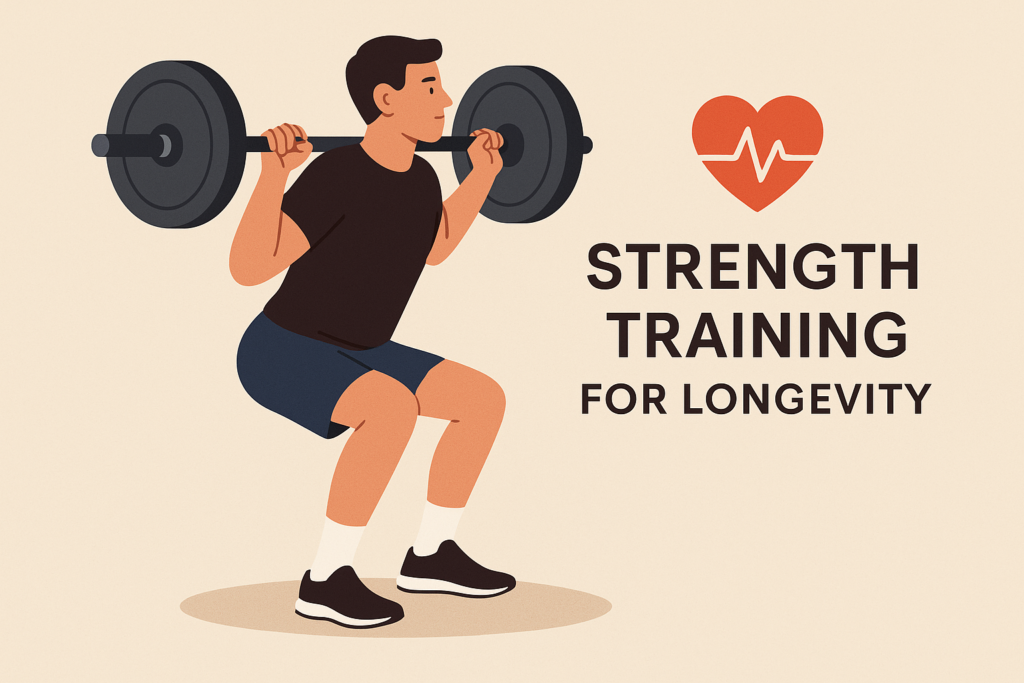
Strength: simple full-body strength protects muscle, joints, posture, and independence.
Strength Training for Longevity → -
Power & balance: moving fast and staying stable reduces fall risk and keeps life feeling “easy”.
Power Training After 40 → • Balance Training Blueprint → -
Mobility & joint capacity: keeps movement accessible, especially when life gets busy or stress is high.
Joint Health for Life → • Mobility for Longevity (10-min flow) →
If you only do one thing: protect daily movement. Then add strength. Then add Zone 2.
3. The Minimum Effective Dose approach (MED)
The Minimum Effective Dose is the smallest amount of training that still produces meaningful benefits. The goal is to build a plan that survives bad weeks — because bad weeks are inevitable.
Your MED “non-negotiables”
- Daily movement: a short walk + light activity most days (even 10–20 minutes counts).
- Strength: 2 sessions/week (20–40 minutes) or 1 session/week on busy weeks.
- Zone 2: 1–2 sessions/week (20–45 minutes), gentle enough to recover from.
- Mobility: 5–10 minutes on most days, especially hips/ankles/thoracic spine.
This is how you stay consistent without needing willpower. Deep dive: Minimum Effective Dose Exercise for Longevity.
4. A weekly blueprint you can actually repeat
Below are two templates: one for “normal life” and one for “busy life”. Both work. Pick the one you can repeat.
Template A: Normal weeks (recommended)
- Daily: 7,000–10,000 steps (or 30–60 minutes total light movement).
- Strength (2×): full-body sessions (20–45 minutes).
- Zone 2 (2×): 25–45 minutes conversational pace.
- Power/balance (2–3×): 5–10 minutes added onto warm-ups.
- Mobility (most days): 5–10 minutes.
Template B: Busy weeks (still counts)
- Daily: 20–30 minutes walking (can be split into 2–3 short walks).
- Strength (1×): one full-body session.
- Zone 2 (1×): 20–30 minutes easy.
- Mobility: 5 minutes most days.
Simple weekly layout (example)
- Mon: Strength + 10 min walk
- Tue: Zone 2 + mobility
- Wed: Steps + balance (5–10 min)
- Thu: Strength + short walk
- Fri: Zone 2 (easy) + mobility
- Sat: Long walk / hike / active day
- Sun: Light movement + mobility reset
Prefer home workouts? Try: Simple Home Zone 2 Routine (No Equipment).
If you want to tighten the synergy between training and metabolism, pair this with your Foundations guide on metabolic flexibility.
5. How to progress without burning out
Progress should feel almost boring. The fastest way to quit is chasing intensity every session. Instead, use simple progression rules:
- Add time before intensity: extend walks / Zone 2 sessions by 5 minutes first.
- Add reps before load: build confidence and joint tolerance, then add weight gradually.
- Keep “hard days” rare: most sessions should feel sustainable.
- Deload when life is heavy: stress counts as training load.
Related: VO₂ Max Explained • Longevity Cardio Mixing Protocols
6. If you’re starting from low fitness
Start where you are — not where you think you “should” be. Your first goal is simply building the identity: I move every day.
- Begin with 5–10 minutes walking once or twice a day.
- Add one short strength session per week (10–20 minutes).
- Use the talk test for Zone 2 (you can speak in sentences).
- Make it easy: shoes by the door, calendar reminder, same time each day.
If you want one “first post” to reinforce the habit loop, start here: Walking as a Longevity Superpower.
7. Common mistakes that derail consistency
- Doing too much too soon. The plan should feel slightly too easy in week 1.
- Overcomplicating strength. You only need a handful of repeatable movements.
- Ignoring daily movement. Steps are “free wins” for metabolism and recovery.
- Only training intensity. Zone 2 and consistency do most of the longevity heavy lifting.
- Skipping balance/mobility. The goal is pain-free movement that lasts.
Useful next reads: Joint Health for Life • Posture & Longevity
8. Next steps (deeper guides)
Use this blueprint as your “default” weekly rhythm, then go deeper based on your bottleneck: strength, cardio, balance, mobility, or simply getting more daily movement.
Strength & muscle
- Strength Training for Longevity
- Strength Training After 40
- Why Muscle Is an Ageing Organ
- How to Prevent Muscle Loss With Age
Cardio & fitness
- Zone 2 Cardio for Longevity
- How to Calculate Your True Zone 2 Heart Rate
- VO₂ Max Explained
- Longevity Cardio Mixing Protocols
- Simple Home Zone 2 Routine (No Equipment)
Balance, power & mobility
- Balance Training Blueprint
- Power Training After 40
- Mobility for Longevity (10-min flow)
- Joint Health for Life
- Posture & Longevity
- Grip Strength & Longevity
Daily movement
Want the “other half” of the equation? Movement works best when sleep and stress support recovery: Sleep & Recovery • Stress & Nervous System.
Frequently Asked Questions
Do I need a gym for this blueprint?
No. You can do the fundamentals at home with bodyweight, a resistance band, and (optionally) light dumbbells.
How long will it take to see benefits?
Most people notice better energy and sleep within 2–4 weeks. Strength and aerobic fitness build steadily over months.
Can I do Zone 2 and strength on the same day?
Yes. Keep Zone 2 truly easy and avoid stacking two hard sessions. A gentle walk after strength can work well.
Is walking really enough?
Walking is foundational and does a lot for metabolism, circulation, and mood. It’s not a replacement for strength training, but it makes everything else easier to sustain.
Disclaimer: This content is for education and does not replace medical advice. If you have injuries, medical conditions, or are starting after a long break, consider speaking with a qualified professional.
Written by Longevity Simplified — making movement simple, sustainable and science-informed.
Next step: Get our free Longevity Starter Guide with simple daily habits.

Simon is the creator of Longevity Simplified, where he breaks down complex science into simple, practical habits anyone can follow. He focuses on evidence-based approaches to movement, sleep, stress and nutrition to help people improve their healthspan.