DNA Damage & Repair Explained: What It Means for Ageing (Without the Jargon)
Your DNA is constantly being damaged and repaired. Ageing accelerates when repair systems slowly fall behind the damage load.
← Back to: Biology of Ageing Explained
Disclaimer: This article is for educational purposes only and does not provide medical advice. It is not intended to diagnose, treat or prevent disease. Always consult a qualified professional for medical concerns.
Every cell in your body carries a complete instruction manual — your DNA. Those instructions tell cells how to build proteins, regulate energy, repair tissue and respond to stress.
However, DNA is not static or perfectly protected. Every day, it is damaged by normal metabolism, environmental exposures, inflammation and simple wear-and-tear.
Fortunately, your body has powerful repair systems that continuously fix these errors. Ageing accelerates when damage begins to accumulate faster than repair can keep up.
This guide explains DNA damage and repair in simple terms, why repair efficiency declines with age, and how everyday habits influence genomic stability over decades.
Personal observation: What surprised me most is how much DNA damage comes from perfectly normal living — breathing, eating, exercising. Longevity isn’t about avoiding damage completely, but keeping repair systems strong enough to stay ahead.
1) The simple explanation
Think of DNA like a massive instruction book copied billions of times across your body.
Every day:
- pages get smudged
- letters get misprinted
- small tears appear
Your cells constantly scan the book and fix these errors. When repair keeps pace, function stays stable. When repair lags behind, errors accumulate — and biological ageing accelerates.
2) What DNA damage actually means
DNA damage refers to physical or chemical changes to the DNA molecule that disrupt accurate genetic information.
Common types of damage include:
- single-base mutations
- strand breaks
- cross-links between DNA strands
- oxidative modifications
Damage comes from:
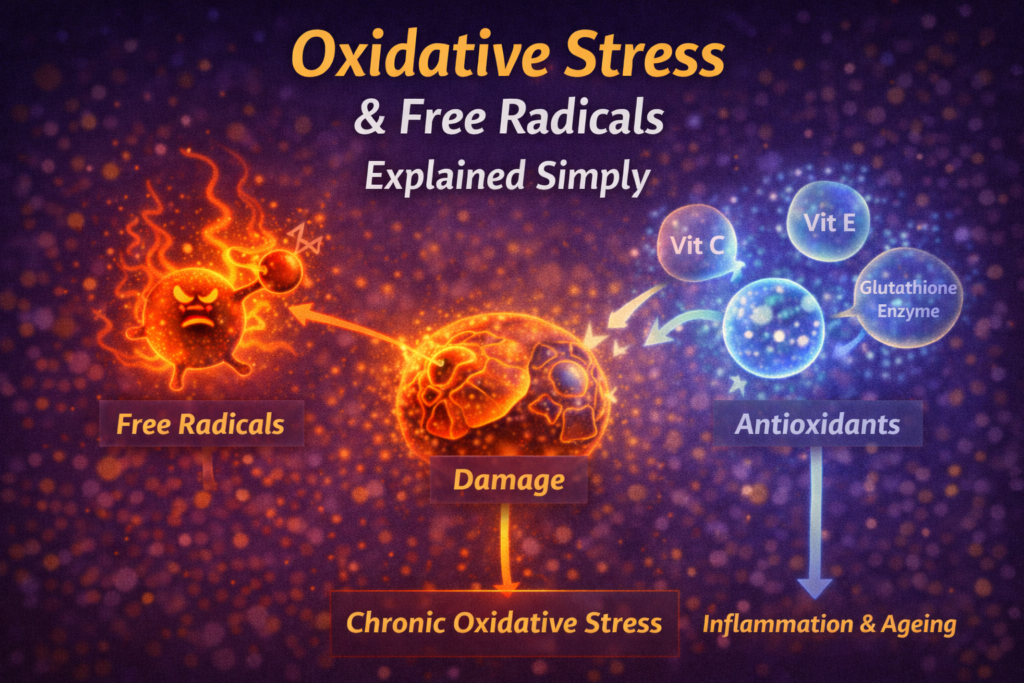
- normal metabolism and oxidative stress
- sunlight and radiation
- environmental toxins
- chronic inflammation
- glycation and metabolic by-products
See: Oxidative Stress Explained Simply and Glycation & AGEs.
3) How DNA repair works
Cells have multiple overlapping repair systems designed to detect and fix different types of damage.
Base excision repair
Fixes small chemical alterations caused by oxidation and metabolic stress.
Nucleotide excision repair
Removes bulky distortions caused by UV light and toxins.
Mismatch repair
Corrects copying errors during cell division.
Double-strand break repair
Repairs dangerous breaks in both DNA strands — critical for genomic stability.
These systems require:
- energy
- adequate protein turnover
- low inflammatory burden
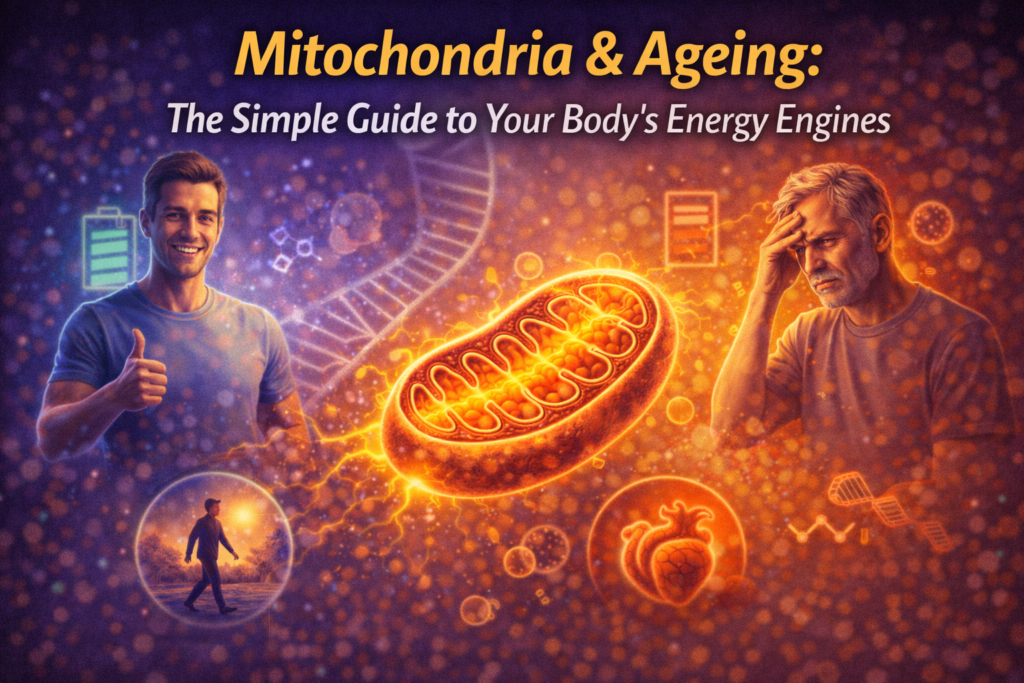
This connects directly to: Proteostasis Explained Simply and Mitochondria & Ageing.
4) Why DNA repair declines with age
Accumulated damage load
Over decades, repair systems face increasing molecular burden.
Reduced energy availability
Repair processes are energy intensive. Mitochondrial decline limits repair capacity.
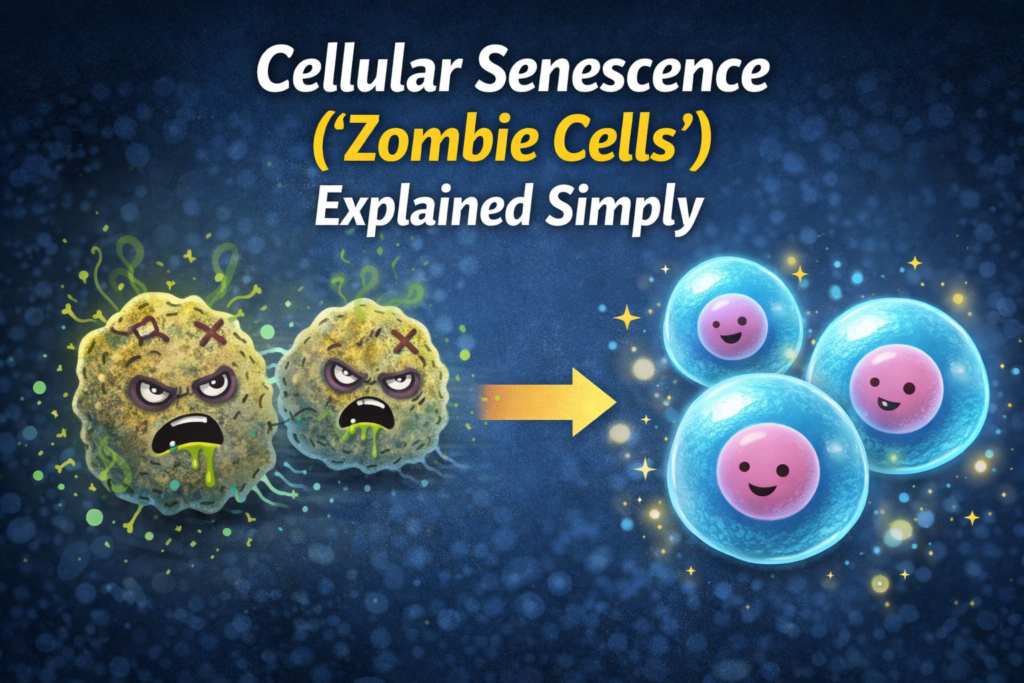
Inflammation and senescence
Chronic inflammation interferes with repair signalling. Senescent cells secrete damaging signals.
See: Cellular Senescence.
Slower protein quality control
Repair enzymes themselves require proteostasis to remain functional.
Related: Autophagy Explained Simply.
5) How DNA damage connects to other ageing pathways
- Telomeres: shortened telomeres increase genome instability
- Mitochondria: mitochondrial DNA damage impairs energy production
- Inflammation: DNA damage activates immune signalling
- Senescence: unrepaired damage drives cellular arrest
- Metabolic signalling: insulin resistance increases oxidative load
Explore: Telomeres Explained, Stress and Inflammation, Insulin Resistance.
6) How to support DNA repair in real life
Protect sleep consistency
Sleep supports DNA repair enzymes and hormonal regulation.
See: Sleep for Longevity.
Maintain metabolic stability
Stable blood sugar reduces oxidative and glycation load.
Exercise regularly (not excessively)
Exercise improves repair signalling but excessive stress can backfire.
Related: Hormesis Explained Simply and Overtraining and Ageing.
Reduce chronic inflammation and stress
Nervous system regulation protects repair capacity.
See: Stress and Longevity.
Eat nutrient-dense whole foods
Micronutrients support enzymatic repair systems.
FAQ
Is DNA damage inevitable?
Yes — damage occurs daily. Longevity depends on repair efficiency, not elimination of damage.
Does DNA damage always lead to cancer?
No. Most damage is repaired successfully. Cancer arises when repair fails repeatedly.
Can supplements improve DNA repair?
Evidence is mixed. Lifestyle remains the dominant factor.
Does ageing slow DNA repair in every tissue?
Decline varies by tissue, metabolic load and lifestyle factors.
Final takeaway
DNA damage is unavoidable — but accelerated accumulation is not.
Supporting energy production, reducing inflammation, stabilising metabolism and protecting sleep helps repair systems stay ahead of damage across decades.
— Simon
References
- López-Otín C et al. (2013). The Hallmarks of Aging. Cell.
- Hoeijmakers JH. (2009). DNA damage, aging, and cancer. New England Journal of Medicine.

Simon is the creator of Longevity Simplified, where he breaks down complex science into simple, practical habits anyone can follow. He focuses on evidence-based approaches to movement, sleep, stress and nutrition to help people improve their healthspan.