Signs You’re Training Too Hard for Your Current Stress Level
Exercise should regulate stress, not amplify it. If recovery is failing, your training dose may be mismatched to your nervous system capacity.
Disclaimer: This article is for educational purposes only and does not provide medical advice. If you have chest pain, unexplained shortness of breath, fainting, suspected overtraining syndrome, or a medical condition affecting exercise tolerance, consult a qualified clinician.
Training is one of the best tools we have for longevity. It strengthens the heart, protects muscle, improves metabolic health and supports mood.
But here’s the part most people miss: training is also a stressor. That’s not bad — it’s how adaptation happens. The problem begins when your overall stress load is already high and your recovery capacity is low.
In that state, hard training stops being “good stress” and becomes another demand your nervous system can’t digest. The result isn’t just soreness — it’s sleep disruption, anxiety spikes, cravings, crashes and a general sense that you’re not bouncing back.
Personal observation: The clearest sign for me isn’t performance — it’s sleep. If a training block makes me wake up wired or adds evening anxiety, that’s a strong signal the intensity is too high for the week I’m having, even if I feel “motivated” in the moment.
1) The simple explanation
Training stress + life stress share the same recovery budget. If work, sleep, relationships, travel, illness, parenting or anxiety are already using most of that budget, your body has less capacity to adapt to high-intensity training.
This is why the “perfect” training plan can fail during a stressful period — and why the best longevity plan changes with your season of life.
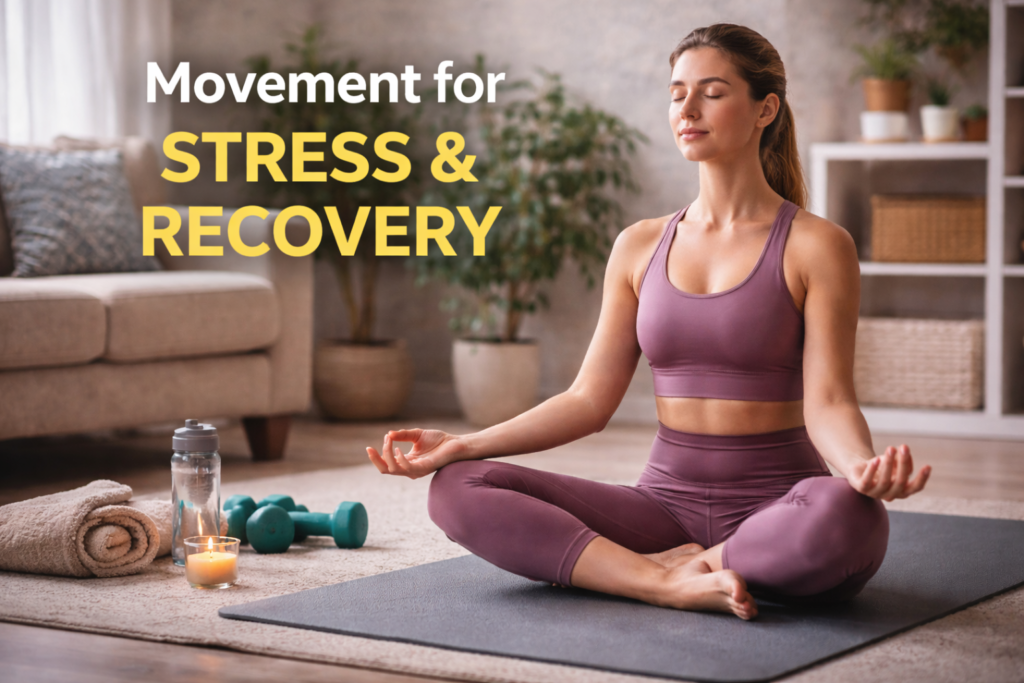
If you want the foundational framework for matching movement to recovery, start here: High vs Low Cortisol Training Days and Movement for Stress & Recovery.
2) The most common signs you’re training too hard (for right now)
🚩 Your sleep gets worse
- difficulty falling asleep after intense sessions
- night waking with a “wired” feeling
- lighter sleep even with the same time in bed
Sleep and stress amplify each other. If training worsens sleep, the loop intensifies: Why Poor Sleep Makes Stress Worse.
🚩 You feel more anxious or irritable
- lower stress tolerance
- feeling “on edge” after workouts
- evening anxiety spikes
Related: Evening Anxiety.
🚩 Cravings and hunger feel louder
- strong sugar cravings at night
- snacking for relief rather than hunger
- energy crashes the next day
See: Stress Appetite and Stress and Blood Sugar Instability.
🚩 Your performance stalls (or regresses)
- weights feel heavier than usual
- pace feels harder at the same effort
- heart rate runs higher than normal
🚩 You’re sore for longer
- DOMS lasts longer than usual
- joints feel “grumpy”
- minor niggles accumulate
🚩 Motivation becomes “compulsive”
A subtle sign: you feel like you must train hard to feel okay. That can indicate training has become a stress regulation tool that’s now overshooting the mark.
3) Why this happens (stress biology)
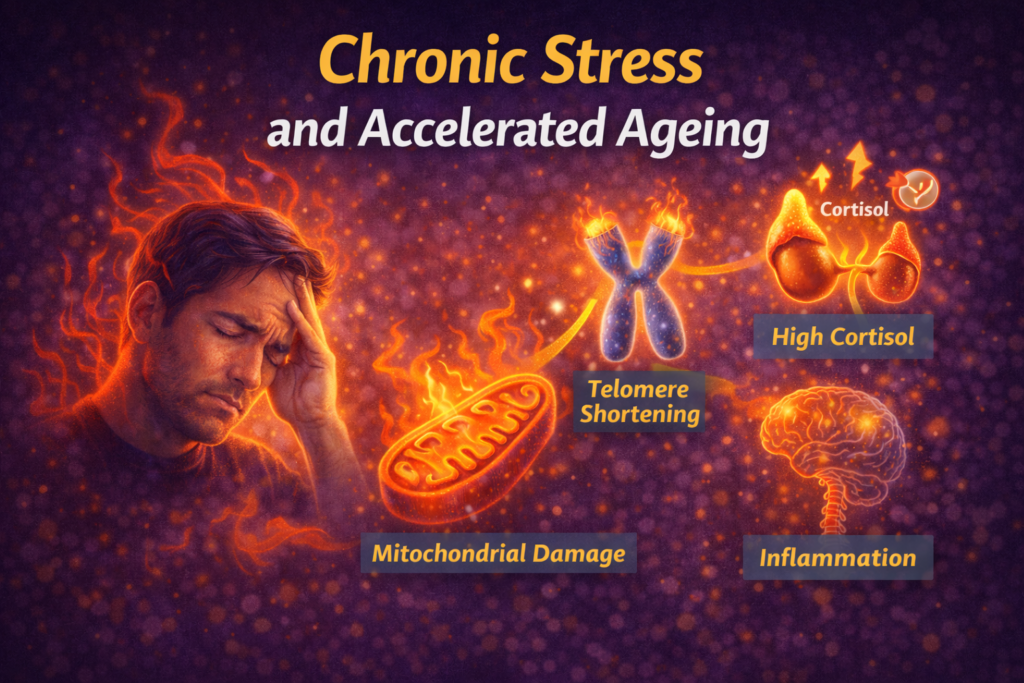
High-intensity training increases sympathetic activation and stress hormones. That’s normal. But if the baseline stress load is already high, you don’t get the clean recovery curve afterward.
Instead, you get:
- more inflammation load
- more sleep disruption
- worse glucose stability
- suppressed HRV trend
- higher resting heart rate
This connects directly to: Stress and Inflammation.
4) What to do instead (how to downshift training)
Option 1: Keep frequency, reduce intensity
This is often the best move. Keep the habit, reduce the stress dose.
- strength sessions: reduce sets or load slightly
- swap HIIT for Zone 2
- replace “failure” training with “leave 2 reps in reserve”
Option 2: Keep intensity, reduce volume
If you love intensity, keep one hard session — but reduce the total weekly load.
Option 3: Replace intensity with recovery movement
Walking, mobility, light cycling, and breathwork-based downshifts. This supports regulation instead of draining it.
Pair with: The 2-Minute Downshift.
5) A simple “high-stress week” training template
If life is heavy, use this as a default week:
- 2 strength sessions (moderate effort, stop short of failure)
- 2–4 Zone 2 / easy cardio sessions (low intensity, conversational pace)
- daily walking (even 20–40 minutes helps)
- 1–3 short downshifts (2 minutes each)
It’s not flashy, but it maintains fitness while protecting recovery. This is how consistency beats intensity over the long run.
6) How wearables can warn you early
Wearables can reveal early strain before burnout:
- HRV trend suppressed for multiple days
- resting heart rate creeping upward
- sleep fragmentation increasing
- recovery scores worsening despite “doing everything right”
Use trends, not single readings: Wearables & Recovery Tracking and Tracking Trends, Not Daily Noise.
FAQ
Does this mean I should avoid intense training?
No. Intensity is valuable — but it must match your current recovery capacity.
How do I know if it’s overtraining or just a bad week?
Look at patterns over 1–3 weeks. If sleep and mood keep deteriorating, downshift.
What’s the fastest way to feel better?
Reduce intensity for 7–10 days and prioritise sleep timing. Add short downshifts daily: The 2-Minute Downshift.
Does this matter for longevity?
Yes. Chronic under-recovery increases inflammation, metabolic strain and injury risk. Longevity training is about sustainability.
Final takeaway
If training is making you sleep worse, crave sugar more, and feel more anxious — the problem may not be you. The problem may be the dose.
The most “elite” longevity skill is not pushing harder. It’s adjusting intelligently so you can keep moving for decades.
— Simon
References
- Meeusen R et al. (2013). Prevention, diagnosis and treatment of the Overtraining Syndrome. European Journal of Sport Science.
- American College of Sports Medicine — Exercise recovery principles (general guidance). Reference

Simon is the creator of Longevity Simplified, where he breaks down complex science into simple, practical habits anyone can follow. He focuses on evidence-based approaches to movement, sleep, stress and nutrition to help people improve their healthspan.