Stress • Nervous System • Pillar
The Nervous System Ladder: How to Regulate Stress for Longevity
Longevity isn’t about eliminating stress — it’s about learning how to move your nervous system up and down the ladder.
Most people think stress is something to reduce or avoid.
However, stress itself isn’t the problem. The real issue is getting stuck in the wrong state for too long — activated all day, or shut down and flat for weeks.
Your nervous system is designed to shift between states: activation, focus, calm, rest, recovery. When that flexibility is lost, everything gets harder: sleep, mood, blood sugar, training recovery, and even your ability to be consistent with healthy habits.
The Nervous System Ladder is a simple framework I use to make this practical. Instead of asking “How do I eliminate stress?”, you ask: Where am I on the ladder right now — and what’s the next small step?
In this guide, you’ll learn:
- what the nervous system ladder is (and how to use it daily)
- the three core states that show up in real life
- why flexibility matters more than “being calm”
- tools to move up or down in minutes
- a weekly template for resilience that actually sticks
1) What the Nervous System Ladder Is
The ladder is a simplified way of describing how your autonomic nervous system shifts between states.
Rather than being “on” or “off”, you move up and down based on:
- threat vs safety signals (deadlines, conflict, overstimulation)
- sleep and recovery debt
- movement, breath, posture and pace
- caffeine, alcohol, and digital stimulation
- food timing and blood sugar swings
Longevity depends on flexibility: the ability to mobilise when needed, and then return to calm efficiently.
If you want the “big picture” first, start here: Stress & Longevity. If you want quick tools, go here: Reset Techniques.
2) The Ladder Map (Simple State Chart)
Here’s the most useful way to think about it:
The Ladder (real-life version)
- Top rung: Activated / mobilised (focused, driven, tense, “go-go-go”)
- Middle rung: Calm / regulated (steady, present, social, able to recover)
- Bottom rung: Shutdown / low energy (flat, foggy, depleted, withdrawn)
You don’t need to live in the middle all day. You need to visit the middle often.
Key idea: the ladder is directional. If you’re at the top, you need “downshift” tools. If you’re at the bottom, you need “gentle activation” tools — not more pressure.
3) The Three Core Nervous System States
Bottom rung: Shutdown / low energy
This looks like low motivation, fatigue, brain fog, emotional flatness, and avoidance.
Common contributors:
- sleep debt or irregular sleep
- under-fuelling, dehydration, low protein
- long-term stress overload (you’ve been “on” for too long)
- poor recovery after illness or burnout
Staying here too long reduces movement, social engagement, and metabolic health — which quietly speeds decline.
Middle rung: Calm and regulated
This is the baseline that supports longevity: steady energy, emotional balance, digestion, and recovery.
In this state:
- sleep comes more easily
- your body repairs and adapts better
- you can focus without being wired
- you tolerate stress without spiralling
Top rung: Activated / mobilised
This supports short bursts of stress — and it’s not “bad”. You need it for work, training, problem-solving and motivation.
The problem isn’t activation. The problem is activation without recovery — staying keyed up into the evening, then repeating it again tomorrow.
If your pattern is “wired but tired” or anxiety spikes, read: Anxiety, Cortisol & Ageing.
4) Why Flexibility Affects Longevity
When you’re stuck at the top rung for too long, you accumulate chronic stress load. Over time this is linked with:
- higher cortisol exposure
- higher inflammation signalling
- sleep fragmentation and shorter deep sleep
- worse insulin sensitivity and cravings
- reduced recovery from training and life
When you’re stuck at the bottom rung, you lose the “inputs” that protect ageing: movement, muscle maintenance, sunlight, social connection, appetite and routine.
Healthy ageing requires oscillation: effort followed by recovery — stress followed by downshift.
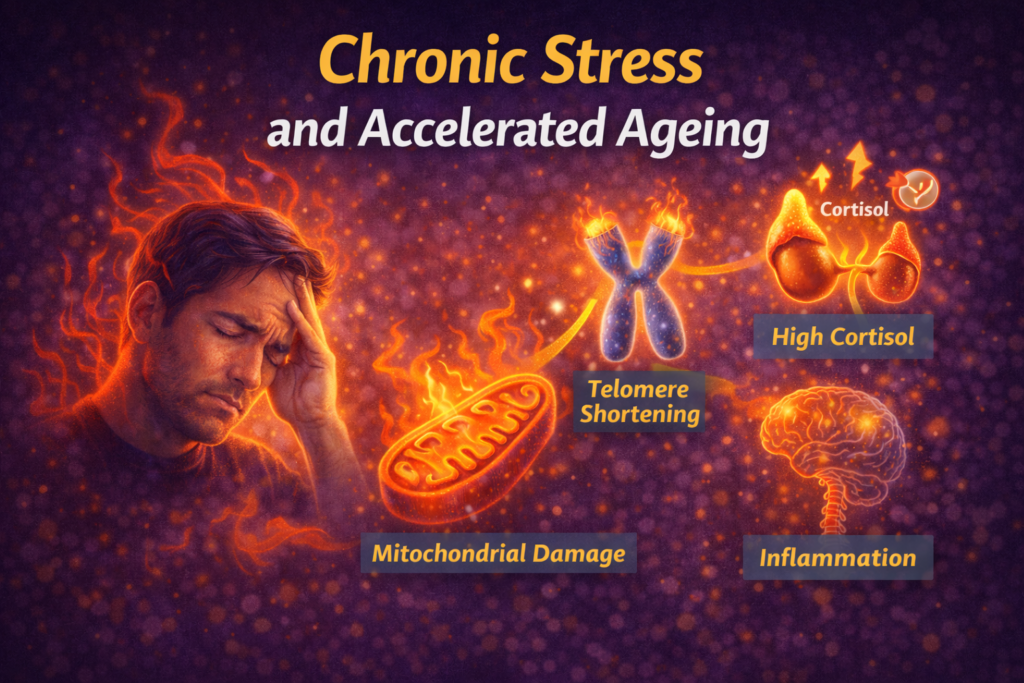
If you want the deeper “why chronic stress accelerates ageing”, go here: Chronic Stress & Accelerated Ageing.
5) Signals You’re Stuck (Top or Bottom)
Signs you’re stuck at the top (over-activated)
- “tired but wired”
- racing mind at night, difficulty winding down
- low tolerance to noise, people, or small stressors
- jaw/shoulder tension, shallow breathing
- needing caffeine to function, then feeling worse later
Signs you’re stuck at the bottom (shutdown/depleted)
- brain fog, flat mood, avoidance
- low motivation to move
- sleep that doesn’t refresh you
- social withdrawal
- everything feels “too much”
Important: these aren’t character flaws. They’re physiological signals. The ladder gives you a next step, not a judgement.
6) Tools to Move Up or Down the Ladder
The goal is to use the right tool for the state you’re in.
To move down (from activated → regulated)
- Extended exhale breathing: in through nose 4 seconds, out 6–8 seconds (2–5 minutes)
- Physiological sigh: two short inhales + long exhale, repeat 3–5 times
- Slow walk: 10–20 minutes, easy pace, ideally outdoors
- Reduce stimulation: screens off + dim environment for 30–60 minutes
Use these next: Breathwork That Lowers Cortisol Fast and Nervous System Reset Techniques.
To move up (from shutdown → gentle activation)
- Light + movement combo: 5–10 minutes of walking (even indoors) + bright daylight if available
- Protein + hydration: water + a real meal (not just caffeine)
- Short “movement snack”: 60 seconds of squats, stair walk, or brisk walk
- One small task: reduce overwhelm by doing the smallest next action
If movement is your best lever, use: Movement for Stress & Recovery.
The ladder isn’t about “always calm”. It’s about choosing the right direction — and moving one rung at a time.
7) The 2-Minute Ladder Reset (Anytime)
If you only do one thing from this article, make it this. It works mid-day, before sleep, or during stress spikes.
2-minute reset
- Name the rung: “Top / Middle / Bottom” (no analysis, just label)
- Breathe 6 cycles: inhale 4 seconds, exhale 6–8 seconds
- Change input: stand up, step outside, or move rooms (tiny environmental shift)
- Choose next action: one small step that matches your state
For more options, bookmark: Reset Techniques.
8) Building Daily Nervous System Resilience
Resilience is built through repeated safety signals. Small daily inputs tell your body: “We’re okay — you can recover.”
A simple daily template
- Morning: light movement + hydration (avoid starting the day in a stress sprint)
- Midday: 2-minute ladder reset between tasks
- Afternoon: short walk or movement snack (stress hormones have somewhere to go)
- Evening: deliberate downshift (breathing + lower stimulation)
If you want the “why + habits” foundation, read: Stress & Longevity.
9) Training & Stress: Match the Day
One of the fastest ways to get stuck at the top rung is training hard on a day your nervous system can’t recover from.
Longevity training is about timing: push when your system is ready, and protect recovery when it isn’t.
Use this guide to choose the right session: High vs Low Cortisol Training Days.
If your nervous system is already “hot” (poor sleep, high anxiety, lots of life stress), the longevity move is often: walk, mobility, easy strength, early night.
10) When to Seek Professional Help
Tools like breathwork and movement help. But if you’re overwhelmed, stuck, or symptoms are severe, support matters.
- panic attacks, persistent anxiety, or trauma symptoms
- sleep disruption that doesn’t improve with basics
- persistent low mood, withdrawal, or loss of enjoyment
- using alcohol/drugs/behaviours to cope
- thoughts of self-harm (urgent)
In the UK, you can start with your GP, and you may be able to self-refer to NHS talking therapies in many areas.
FAQs
Is stress always bad for longevity?
No. Short-term stress followed by recovery builds resilience. The problem is long-term stress load without downshifts.
Can breathing exercises really help?
Yes. Breathing directly influences nervous system state, especially when the exhale is longer and slower.
What does “nervous system flexibility” actually mean?
It means you can mobilise when needed, then return to a regulated baseline efficiently — instead of staying stuck at the top or bottom.
Does this replace therapy or medical care?
No. It complements support, but doesn’t replace professional care — especially for severe anxiety, depression, trauma, or panic.
Final Takeaway
Longevity isn’t built by staying calm all the time.
However, it is undermined when your nervous system loses flexibility.
Learn to climb the ladder when you need focus and action. Learn to descend when it’s safe. Repeat daily.
Longevity belongs to those who can shift states — not those who stay stuck.
— Simon, Longevity Simplified
References
- Frontiers in Neuroscience — Autonomic regulation, stress physiology, and health outcomes (overview articles)
- Journal of Gerontology — Stress, resilience, and ageing biology (review literature)
- NHS — Stress information and self-help resources
Disclaimer: This content is for educational purposes only and does not constitute medical advice.

Simon is the creator of Longevity Simplified, where he breaks down complex science into simple, practical habits anyone can follow. He focuses on evidence-based approaches to movement, sleep, stress and nutrition to help people improve their healthspan.