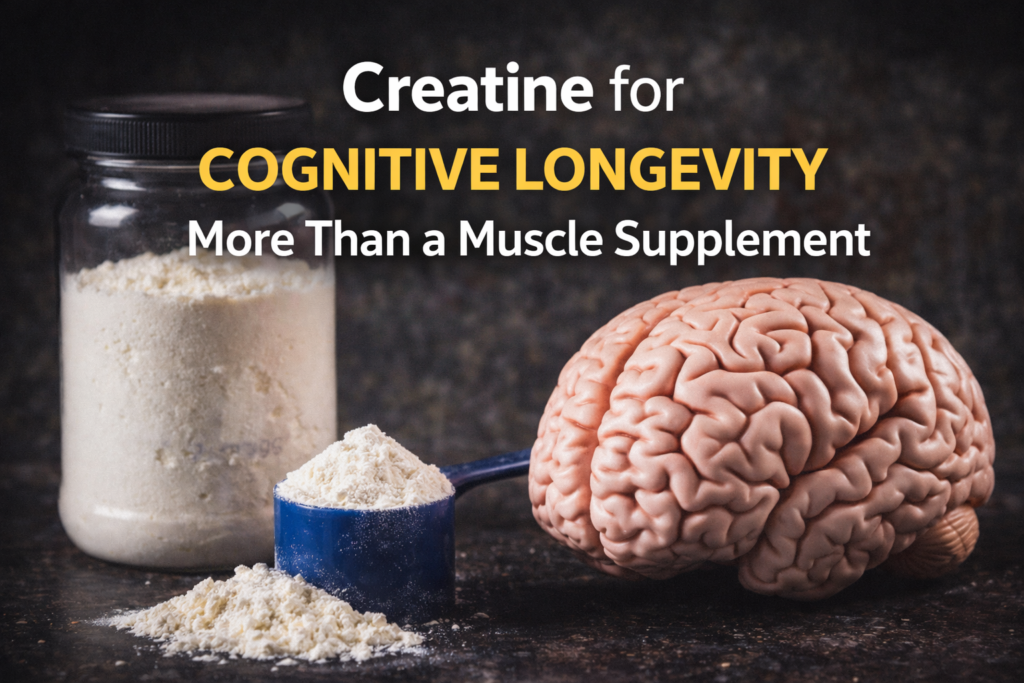
Creatine for Women: Strength, Brain Health and Healthy Ageing
Creatine isn’t just for bodybuilders. For women, it supports muscle preservation, cognitive resilience, energy metabolism and long-term independence — especially as protein intake and muscle mass naturally decline with age.
← Back to: Best Supplements for Longevity (UK Guide)
Disclaimer: This article is for educational purposes only and does not provide medical advice. Creatine may interact with certain medical conditions or medications. Consult a qualified healthcare professional before supplementing, especially during pregnancy or if you have kidney disease.
Creatine is often associated with male gym culture and muscle gain. However, this narrow framing misses its broader biological value — especially for women.
Creatine plays a central role in cellular energy production, brain function, muscular resilience and metabolic stability. These systems become increasingly important as women age, navigate hormonal transitions, and seek to preserve strength and cognitive performance.
Yet many women under-consume dietary creatine and protein, making supplementation potentially more impactful than in men.
This guide explains what creatine does in the female body, its benefits for longevity, safety considerations, and how to use it practically without overcomplication.
Personal observation: I’ve seen the biggest real-world benefit when creatine is paired with simple strength training and adequate protein — the supplement amplifies consistency rather than replacing fundamentals.
1) The simple explanation
Creatine helps your cells regenerate energy quickly.
This supports muscle strength, brain function, resilience to fatigue and recovery capacity.
For women, creatine helps preserve lean mass, maintain cognitive performance and support metabolic stability with ageing.
2) What creatine actually does
Creatine increases the availability of phosphocreatine inside cells, which rapidly regenerates ATP — your body’s energy currency.
High-energy tissues rely heavily on this system:
- skeletal muscle
- brain and nervous system
- heart
This improves short-term power output, cellular resilience and energy buffering.
Related biology: Mitochondria & Ageing.
3) Why creatine matters especially for women
Women typically consume less dietary creatine because intake comes largely from red meat and fish.
Hormonal changes across the lifespan influence muscle retention, bone density, cognition and fatigue sensitivity.
Creatine supports these systems directly and indirectly.
This makes it a uniquely useful supplement for women focused on long-term function rather than aesthetics.
4) Muscle preservation and strength
Muscle mass naturally declines with age, increasing injury risk and metabolic instability.
Creatine:
- improves training capacity
- supports lean mass preservation
- enhances neuromuscular performance
Combined with resistance training, it slows sarcopenia and supports independence.
Related: Strength Training for Longevity.
5) Brain health, mood and cognition
The brain consumes large amounts of energy and benefits from enhanced ATP buffering.
Research suggests creatine may support:
- working memory under fatigue
- mental resilience during stress
- mood stability in vulnerable populations
This becomes increasingly relevant during perimenopause and later life.
Related: Brain Energy & Ageing.
6) Energy metabolism and fatigue resistance
Creatine buffers rapid energy demand, helping maintain output during physical and cognitive stress.
This improves training consistency and daily vitality rather than peak performance alone.
For broader context: Energy Supplements That Actually Work.
7) Creatine and healthy ageing
Ageing increases vulnerability to:
- muscle loss
- falls and frailty
- cognitive decline
- metabolic dysregulation
Creatine supports functional reserve — the buffer between daily demands and maximum capacity.
This buffer predicts independence and healthspan more than appearance metrics.
8) Safety, water weight and myths
Creatine is one of the most researched supplements available and is generally safe for healthy adults.
Common concerns:
- Water weight: mild intracellular water retention may occur initially.
- Kidney health: safe in healthy individuals; caution if kidney disease exists.
- Bloating: rare at moderate dosing.
Creatine does not masculinise women or cause fat gain.
9) How to dose creatine
- 3–5g daily of creatine monohydrate
- no loading phase required
- take anytime; consistency matters most
- hydrate adequately
Pair with adequate protein intake for best results.
Related: Protein Leverage Explained.
10) Who benefits most
- women over 35–40
- low meat intake
- strength training beginners
- high cognitive demand lifestyles
- fatigue-prone individuals
Individual response varies.
11) Common mistakes
- skipping strength training
- undereating protein
- expecting rapid cosmetic changes
- inconsistent dosing
- overcomplicating timing
Consistency beats optimisation.
FAQ
Will creatine make me bulky?
No — muscle gain requires training stimulus and sufficient calories.
Can I take creatine during menopause?
Many women benefit due to muscle and cognitive protection.
Is creatine vegan?
Supplemental creatine is synthetic and vegan-friendly.
Do I need to cycle creatine?
No strong evidence supports cycling in healthy users.
Final takeaway
Creatine supports muscle, brain and energy systems that matter increasingly for women as they age.
When paired with simple strength training and adequate protein, it becomes a powerful longevity tool.
— Simon
References
- Candow DG et al. (2019). Effect of creatine supplementation during resistance training in older adults. Journal of Geriatric Physical Therapy.
- Rae C et al. (2003). Oral creatine monohydrate supplementation improves brain performance. Proceedings of the Royal Society B.

Simon is the creator of Longevity Simplified, where he breaks down complex science into simple, practical habits anyone can follow. He focuses on evidence-based approaches to movement, sleep, stress and nutrition to help people improve their healthspan.