Best Oils & Fats for Longevity: What to Use, What to Limit, and Why It Matters
Fats don’t age you — unstable, overprocessed, and misused fats do.
Dietary fats have been blamed, praised, banned, and resurrected over the last century.
However, the longevity impact of fats isn’t about fat vs carbohydrate. It’s about fat quality, stability, and context.
Importantly, the type of fat you cook with, drizzle on food, or consume daily influences inflammation, cardiovascular risk, and metabolic health over decades.
This guide explains:
- which oils and fats best support longevity
- which ones quietly undermine health
- how cooking changes fat behaviour
- how to use fats intelligently in real life
1. Why Fat Quality Matters for Longevity
Fats are more than calories. They are structural components of cell membranes, hormones, and signalling molecules.
Over time, the fats you consume influence:
- inflammation and oxidative stress
- cholesterol particle quality
- insulin sensitivity
- brain and nerve function
Health guidance from organisations such as the :contentReference[oaicite:0]{index=0} increasingly focuses on fat quality rather than blanket fat reduction.
From a longevity perspective, stable, minimally processed fats are protective — unstable industrial fats are not.
2. The Main Types of Dietary Fat
Understanding fat types helps explain why some oils age better than others.
- Saturated fats: chemically stable, heat-resistant
- Monounsaturated fats: stable, anti-inflammatory
- Polyunsaturated fats: essential but oxidation-prone
- Trans fats: industrial, inflammatory, harmful
Crucially, stability matters as much as fatty acid profile.
3. Best Oils & Fats for Longevity
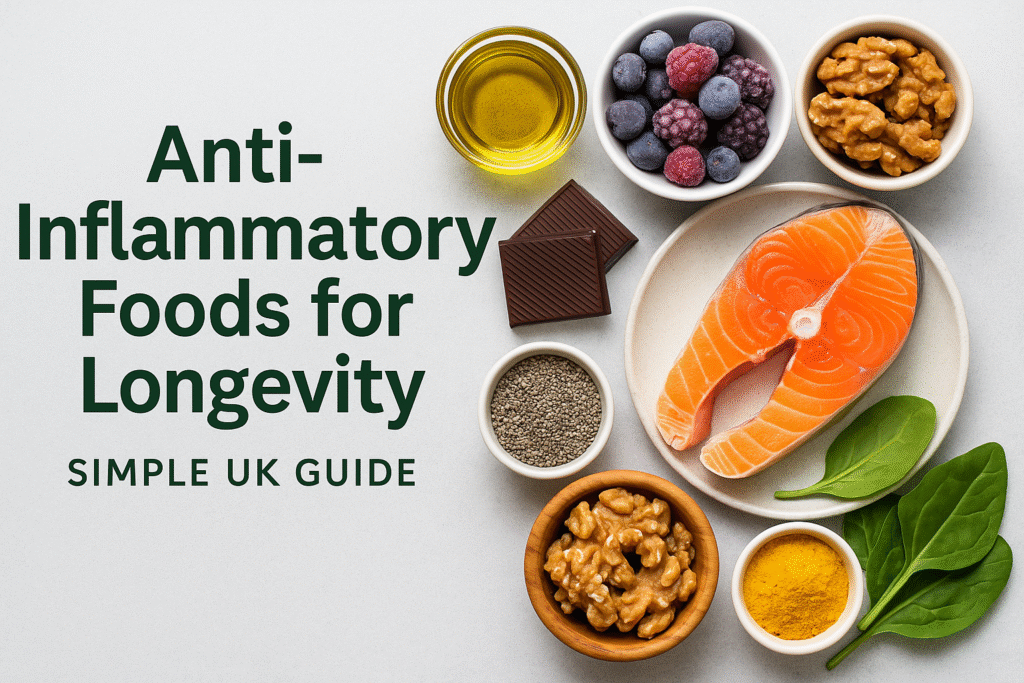
Extra Virgin Olive Oil
The strongest evidence-backed oil for longevity.
- rich in monounsaturated fats
- contains protective polyphenols
- associated with lower cardiovascular risk
Best used for: salads, drizzling, low–medium heat cooking.
Avocado Oil
High in monounsaturated fat with good heat stability.
Best used for: higher-heat cooking.
Butter & Ghee (in moderation)
Saturated fats are heat-stable and resistant to oxidation.
Best used for: occasional cooking, not large daily quantities.
Whole-Food Fats
- nuts and seeds
- olives
- avocados
These deliver fats alongside fibre, minerals, and polyphenols.
→ Internal links: Omega-3 for Longevity | Polyphenols Explained
4. Fats and Oils to Limit
Some oils are problematic not because they’re “bad,” but because of how they’re processed and used.
- refined seed oils (soybean, corn, sunflower)
- repeatedly heated frying oils
- industrial trans fats
In ultra-processed foods, these oils are often oxidised before consumption.
→ Internal link: Ultra-Processed Foods & Ageing
5. Cooking, Heat, and Oxidation
Heat changes fat behaviour.
As a result, oils that are healthy cold may become harmful when overheated.
- use stable fats for high heat
- avoid smoking oils
- discard burnt or reused oils
Oxidised fats increase oxidative stress and inflammation — key drivers of ageing.
6. How to Use Fats for Longevity
A longevity-focused fat strategy is simple:
- prioritise olive oil as your default
- use heat-stable fats for cooking
- avoid deep-fried and reheated oils
- eat fats as part of whole foods
→ Internal links: Optimal Longevity Diet | Blood Sugar Hacks
7. Common Mistakes
- avoiding all saturated fat out of fear
- using “heart healthy” oils at high heat
- assuming calories matter more than oxidation
- overconsuming oils instead of whole foods
Instead, think stability, context, and food quality.
FAQ
Is olive oil safe for cooking?
Yes, especially at low to medium heat. Extra virgin olive oil is more stable than many refined oils.
Are seed oils always harmful?
Not inherently, but their industrial processing and heat sensitivity make them problematic in excess.
Should fat intake be reduced with age?
No. Fat quality matters more than quantity for longevity.
Final Takeaway
Fats are not the enemy of longevity.
However, unstable, oxidised, and industrial fats quietly accelerate inflammation and metabolic stress.
Choose stable oils. Cook thoughtfully. Let whole foods do the heavy lifting.
Longevity isn’t about avoiding fat — it’s about choosing the right ones.
References
- BMJ – Dietary Fats and Mortality
- New England Journal of Medicine – Fat Quality and Cardiovascular Risk
- NHS – Fats and Heart Health
Disclaimer: This content is for educational purposes only and does not constitute medical advice. Always consult a qualified healthcare professional before making major dietary changes.

Simon is the creator of Longevity Simplified, where he breaks down complex science into simple, practical habits anyone can follow. He focuses on evidence-based approaches to movement, sleep, stress and nutrition to help people improve their healthspan.