Antioxidants Explained: Why “More” Isn’t Always Better for Longevity
Antioxidants protect cells from damage — but excessive suppression of oxidative signals can blunt adaptation, resilience and healthy ageing.
← Back to: Biology of Ageing Explained
Disclaimer: This article is for educational purposes only and does not provide medical advice. It is not intended to diagnose, treat or prevent disease. Always consult a qualified professional before making supplement decisions.
Antioxidants are often marketed as universally beneficial — more protection, less damage, slower ageing. It sounds logical.
However, biology is more nuanced. While antioxidants play essential roles in protecting cells, excessive suppression of oxidative signalling can interfere with adaptation, exercise benefits, immune defence and metabolic resilience.
In other words: oxidative stress is not always bad — context matters.
This guide explains what antioxidants actually do, why balance matters more than elimination, and how to support healthy redox signalling for longevity.
Personal observation: The more I studied oxidative biology, the more it resembled stress regulation — too much is harmful, too little signal blunts adaptation. It changed how I view supplementation completely.
1) The simple explanation
Oxidation is a normal byproduct of energy production inside cells.
Reactive oxygen species (ROS) are generated when mitochondria produce energy. At controlled levels, ROS act as important signalling molecules that trigger repair, adaptation and immune defence.
Antioxidants neutralise excess ROS to prevent uncontrolled cellular damage.
The goal is balance — not elimination.
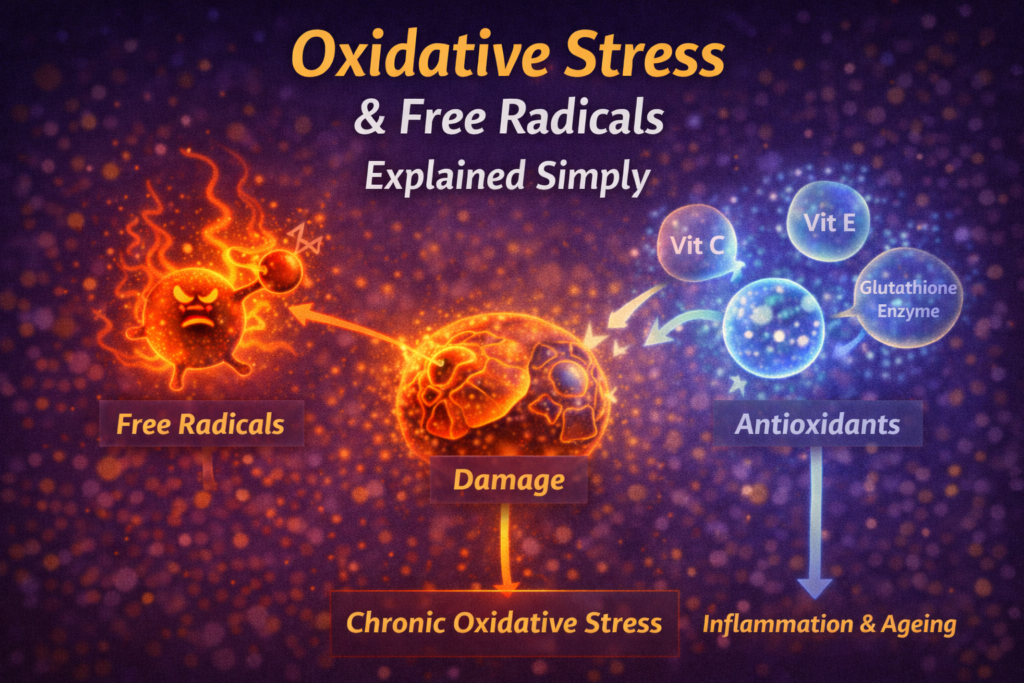
See: Oxidative Stress & Free Radicals Explained Simply.
2) What oxidative stress really is
Oxidative stress occurs when reactive molecules overwhelm protective systems.
Excess oxidative load can damage:
- DNA
- proteins
- lipid membranes
- mitochondrial function
Chronic oxidative stress contributes to:
- accelerated ageing
- inflammation
- metabolic dysfunction
- neurodegeneration
Related: Glycation & AGEs and Mitochondria & Ageing.
3) What antioxidants actually do
Antioxidants donate electrons to stabilise reactive molecules.
The body maintains an integrated antioxidant network including:
- glutathione
- superoxide dismutase
- catalase
- vitamin C
- vitamin E
- polyphenols
Many antioxidants also activate internal repair pathways rather than acting purely as scavengers.
Explore: Glutathione and Polyphenols Explained.
4) Why balance matters more than elimination
ROS are not purely harmful — they act as signalling molecules that trigger:
- mitochondrial biogenesis
- autophagy and mitophagy
- immune defence
- stress adaptation
Excess antioxidant suppression can blunt these adaptive signals.
This is part of the broader hormesis principle: Hormesis Explained Simply.
5) Antioxidants and exercise adaptation
Exercise generates temporary oxidative stress that triggers beneficial adaptation.
High-dose antioxidant supplementation has been shown in multiple studies to blunt:
- mitochondrial biogenesis
- insulin sensitivity improvements
- endurance adaptations
See: Exercise and Mitochondria and Mitochondrial Biogenesis.
6) The problem with high-dose supplements
Large doses of isolated antioxidants bypass normal regulatory systems.
Risks include:
- blunted training adaptation
- impaired immune signalling
- potential pro-oxidant effects at high doses
- uncertain long-term safety
Population studies have not consistently shown mortality benefits from high-dose antioxidant supplementation.
7) Food-based antioxidants vs pills
Whole foods provide antioxidants in balanced matrices alongside fibre, micronutrients and signalling compounds.
Polyphenols often act by activating endogenous defence pathways rather than directly neutralising ROS.
Related: Anti-Inflammatory Foods.
8) How to support healthy redox balance
Eat diverse plant foods
Variety provides balanced antioxidant signalling.
Move regularly
Exercise strengthens endogenous antioxidant systems.
Protect sleep
Repair and detoxification peak overnight.
Avoid chronic overexposure to pollutants
Reduce unnecessary oxidative load.
Related: Air Quality & Longevity.
Be cautious with high-dose supplementation
Supplements should complement — not override — physiology.
FAQ
Are antioxidants bad for you?
No — they are essential. Excess isolated dosing is the concern.
Should I avoid vitamin C or E?
Normal dietary intake is healthy. High-dose chronic supplementation may blunt adaptation.
Are berries and vegetables still beneficial?
Yes — whole foods support balanced signalling.
Do antioxidants prevent ageing?
They reduce damage but do not override systemic ageing processes.
Final takeaway
Antioxidants protect cells — but balance matters more than suppression.
Supporting your body’s own antioxidant systems through lifestyle remains the most reliable longevity strategy.
— Simon
References
- Gomez-Cabrera MC et al. (2008). Oral antioxidants prevent health-promoting effects of exercise. PNAS.
- Ristow M et al. (2009). Antioxidants prevent exercise-induced insulin sensitivity. PNAS.

Simon is the creator of Longevity Simplified, where he breaks down complex science into simple, practical habits anyone can follow. He focuses on evidence-based approaches to movement, sleep, stress and nutrition to help people improve their healthspan.