Active Recovery vs Rest: The Stress Edition
When stress is high, “doing nothing” isn’t always recovery — but neither is pushing through. Here’s how to choose the right dose.
Disclaimer: This article is for educational purposes only and does not provide medical advice. If you have injury, illness, chronic fatigue symptoms, chest pain, dizziness, or medical limitations, consult a qualified clinician before changing activity.
On high-stress days, many people ask the wrong question: “Should I train or skip?”
The better question is: What dose of movement helps my nervous system recover today?
Sometimes that means active recovery (walking, gentle cycling, mobility). Sometimes it means genuine rest. And sometimes it means training — but with intensity adjusted to match your current stress load.
This guide helps you choose correctly, without guilt and without guesswork.
Personal observation: When I’m stressed, “rest days” can accidentally become more draining if I replace movement with screens and rumination. A short walk plus a calm downshift often restores me faster than a full day of doing nothing.
1) The simple explanation
Recovery isn’t the absence of training. Recovery is the presence of the right signals:
- lower nervous system arousal
- better sleep quality
- stable mood and energy
- repaired tissue and replenished fuel
If stress is already high, hard training can overshoot your recovery capacity. That’s why you might feel more anxious, sleep worse, and crave sugar after workouts during stressful weeks.
If you haven’t read it yet, this connects directly to: Signs You’re Training Too Hard for Your Current Stress Level.
2) Active recovery vs rest: what they actually mean
Active recovery
Low-intensity movement designed to reduce stress load and support circulation without creating additional strain. It should feel easy — like you could do it again tomorrow.
Examples:
- walking
- gentle Zone 2 (very easy)
- mobility and stretching
- light cycling
- easy swimming
Rest
True rest is a reduction of total demand — physical, mental and emotional. It’s not “lying down with intense stimulation”.
Examples:
- sleep extension
- quiet downtime
- low-stimulation social connection
- gentle breathing or relaxation practices
Both are useful — the key is choosing the right one for your state.
3) How to choose on a high-stress day
Choose active recovery if:
- you feel mentally stressed but physically okay
- sleep was slightly off but not terrible
- movement usually calms you
- you feel “stuck in your head”
Choose full rest if:
- you slept badly for multiple nights
- you feel run down or borderline ill
- you’re unusually sore or heavy
- you feel wired and exhausted
Choose training (modified) if:
- you slept okay
- your mood is stable
- stress is moderate
- you can keep intensity controlled
A good rule: When stress is high, earn intensity with recovery.
For a broader framework, see: High vs Low Cortisol Training Days.
4) Best active recovery options (stress-friendly)
1) Walking (the underrated king)
Walking lowers arousal, improves glucose stability, and supports recovery with minimal cost. If you do one thing, do a walk.
2) Gentle Zone 2 cardio
Zone 2 can lower stress when truly easy — conversational pace, no pushing. This is not the day to chase targets.
3) Mobility + breath pairing
Combine light mobility with a short reset: The 2-Minute Downshift.
4) Easy strength “grease the groove”
If you love strength work, keep it light: fewer sets, more rest, stop well short of failure.
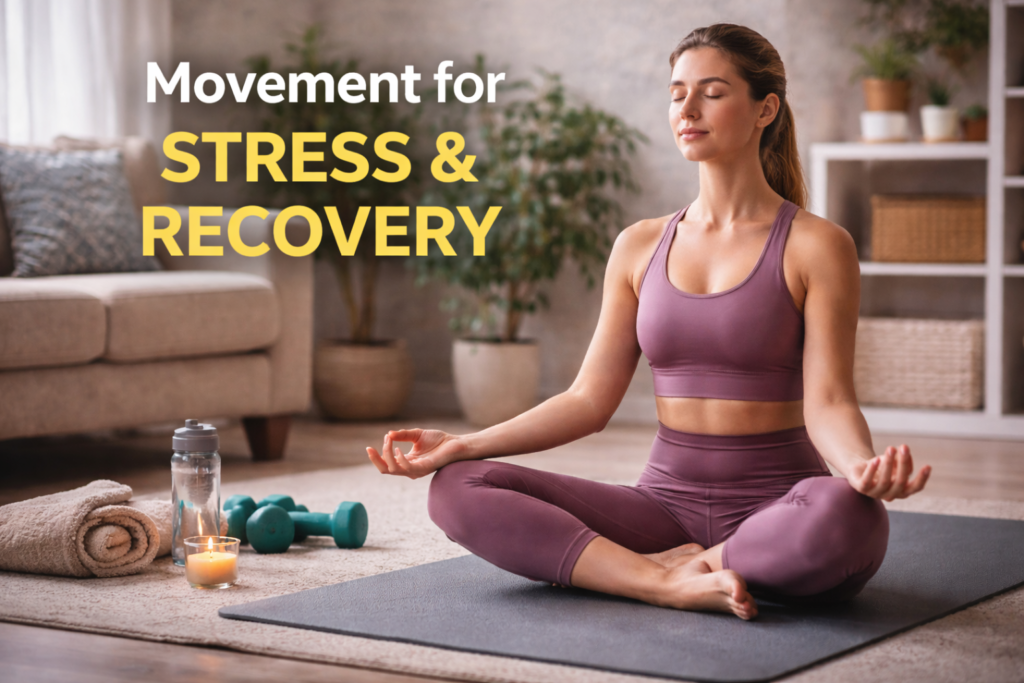
This pairs well with: Movement for Stress & Recovery.
5) When full rest is the right call
Rest is often the best choice when:
- sleep is severely disrupted (especially multiple nights)
- you’re getting ill (sore throat, feverish, heavy fatigue)
- your resting heart rate is elevated for days
- you feel emotionally brittle and overwhelmed
If evening anxiety is a regular pattern, it can also signal your nervous system needs less demand and more downshifts: Evening Anxiety.
6) Common mistakes that worsen recovery
Turning active recovery into “secret training”
If your “recovery walk” becomes a power march where you chase pace, it stops being recovery.
Using rest days for high stimulation
Hours of scrolling, news, and late-night screens often increase stress even if you didn’t exercise.
Replacing training with sugar and caffeine
If you’re tired and wired, cravings rise. Stabilise blood sugar rather than feeding swings: Stress and Blood Sugar Instability and Stress Appetite.
Ignoring the sleep–stress loop
If training worsens sleep, the whole system worsens: Why Poor Sleep Makes Stress Worse.
7) How wearables can guide the choice
Wearables can’t tell you exactly what to do — but they can reveal strain trends that should influence your dose:
- HRV trend suppressed for several days
- resting heart rate creeping upward
- sleep fragmentation increasing
- recovery scores consistently low
If those are present, choose active recovery or rest. Use trends rather than single readings: Wearables & Recovery Tracking and Tracking Trends, Not Daily Noise.
FAQ
Is active recovery always better than rest?
No. If you’re sick, severely sleep deprived, or deeply depleted, rest is the higher-value move.
How long should active recovery be?
20–60 minutes is enough for most people. Keep it easy.
Can I do Zone 2 on a high-stress day?
Yes — if it’s genuinely easy. If you’re pushing, it becomes another stressor.
Does this matter for longevity?
Yes. Longevity training is about sustainability and recovery capacity — not chronic strain.
Final takeaway
The best recovery choice depends on your state.
If stress is high, choose movement that calms you — or rest that truly reduces demand. Avoid the two traps: doing nothing with high stimulation, or doing “recovery” that’s actually training.
— Simon
References
- Meeusen R et al. (2013). Prevention, diagnosis and treatment of the Overtraining Syndrome. European Journal of Sport Science.
- Harvard Health Publishing — Exercise and stress (general overview). Reference

Simon is the creator of Longevity Simplified, where he breaks down complex science into simple, practical habits anyone can follow. He focuses on evidence-based approaches to movement, sleep, stress and nutrition to help people improve their healthspan.